After pregnancy, breastfeeding, weight changes, or aging, many people may notice that their breasts have become smaller and sagging at the same time. The nipples may sit lower, the skin may stretch, and the upper breast tissue may appear flattened.
For those who want to address both breast sagging and loss of breast volume, combining a breast lift with breast implant augmentation—known as Augmentation-Mastopexy—is one option that can be considered. It is a surgery that aims to adjust nipple position and breast shape while increasing volume in the same procedure.
During the October Double Transformation campaign, this article will help you understand the degrees of ptosis according to the Regnault Classification, the criteria that help assess whether augmentation alone is sufficient, the incision patterns used for mastopexy, considerations for one-stage versus two-stage surgery, as well as approaches to preserving blood supply to the nipple-areola complex (NAC), compiled from research referenced in the PubMed database.
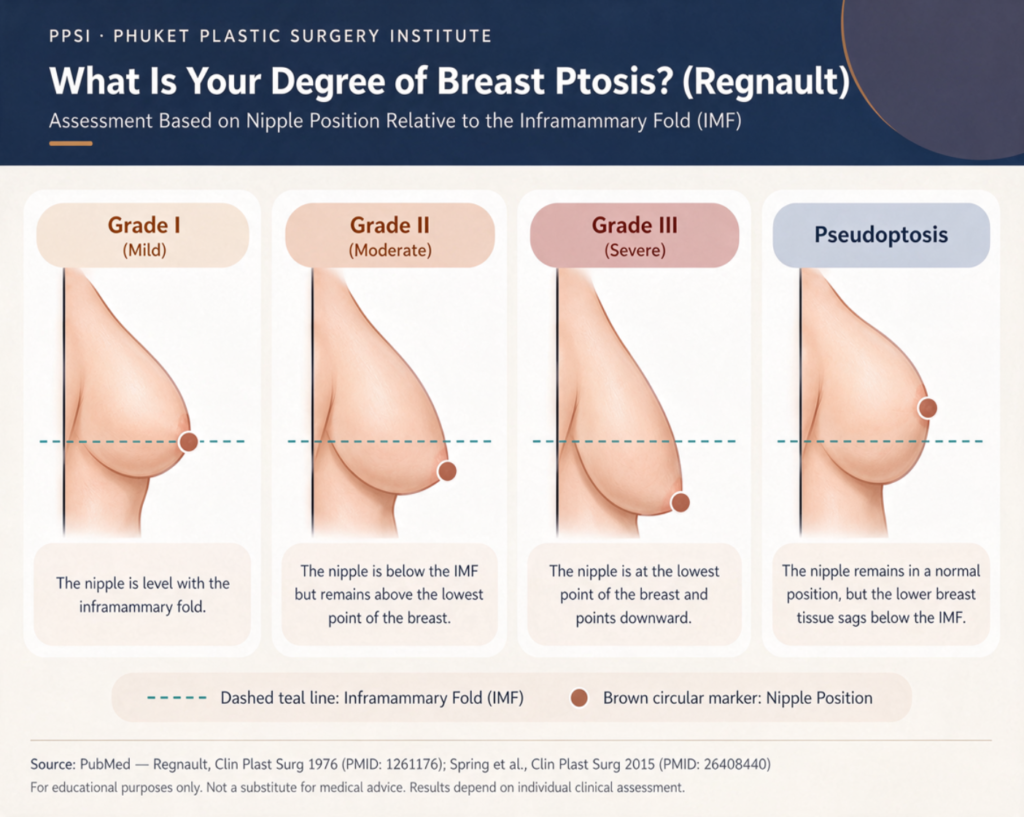
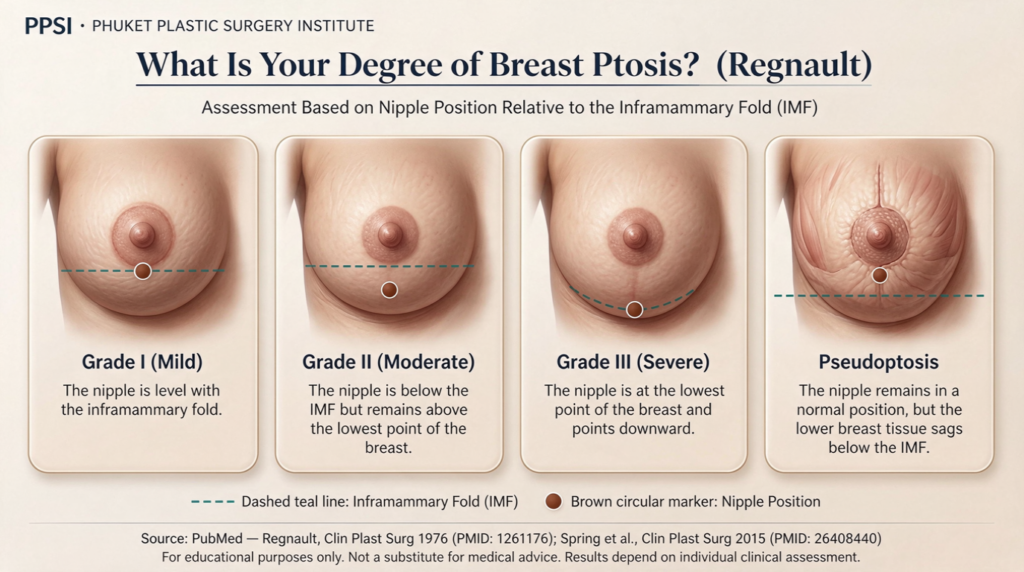
Assessing the Degree of Breast Ptosis According to the Regnault Classification
In 1976, Paule Regnault presented a classification of breast ptosis that remains a foundation for clinical assessment. It considers the position of the nipple relative to the inframammary fold, as well as the characteristics of the breast tissue and the skin envelope.
The classification covers pseudoptosis, partial ptosis, and true ptosis, which is divided into 3 grades. In addition, ptosis may coexist with breast tissue that has low volume (hypoplasia), so both breast position and volume must be considered together.
Degrees of Ptosis and Possible Approaches
Grade 1 (Mild)
The nipple is at the same level as the inframammary fold. If breast tissue is also small, augmentation alone or minor additional lifting may be considered based on examination findings.
Grade 2 (Moderate)
The nipple is below the inframammary fold but still above the lowest border of the breast. Generally, mastopexy is usually required, and breast implants may be added as appropriate.
Grade 3 (Severe)
The nipple is at the lower part of the breast and clearly points downward. Mastopexy is usually required to adjust nipple position and breast shape, along with assessment of whether to add breast implants in the same procedure or divide the surgery into two stages.
Pseudoptosis
The nipple remains in an appropriate position, but the lower breast tissue sags below the inframammary fold. The approach therefore depends on each individual's breast volume and shape.
The above grading is only a preliminary guide. The surgeon must also assess other details, such as the distance from the suprasternal notch to the nipple, the distance from the nipple to the inframammary fold, skin elasticity, and asymmetry between the two breasts, before determining the treatment plan.
When Augmentation Alone May Be Insufficient
A common misunderstanding is that breast implants will lift the breasts entirely on their own. In reality, breast implants primarily serve to increase volume and help fill the upper breast; they do not directly lift the nipple or remove excess skin.
If the nipple is clearly below the inframammary fold, augmentation alone may leave the original breast tissue still sagging in front of the implant, resulting in a shape that does not meet expectations.
Augmentation-Mastopexy therefore must address two challenging goals at the same time: increasing breast volume and lifting to reduce excess skin while adjusting nipple position. This complexity means the surgery requires careful planning, appropriate technique selection, and clear communication of expectations with the patient.
Signs That May Indicate Mastopexy Should Be Considered Together
1. The nipple is below the inframammary fold or points downward.
2. The areola is enlarged or the skin around the breast is stretched.
3. The skin of the lower breast is significantly sagging.
4. The two breasts sag asymmetrically, requiring nipple position adjustment for balance.
However, having these characteristics does not mean everyone must undergo the same procedure. The decision should be based on physical examination and assessment by a surgeon.
Mastopexy Incision Patterns
The choice of incision depends on the degree of ptosis, nipple position, and the amount of skin that needs to be removed. The three main patterns discussed in this article are:
Periareolar / Circumareolar Incision
The incision follows the border of the areola. It is suitable for minor nipple repositioning or areola reduction. The advantage is that the scar lies at the color transition of the skin, so it may be less noticeable than some other patterns.
Vertical / Lollipop Incision
The incision consists of a periareolar component and a vertical line down to the inframammary fold. It allows the surgeon to remove more excess skin from the lower breast and reshape the breast more effectively, making it a pattern that may be considered for moderate ptosis.
Wise Pattern / Anchor / Inverted-T Incision
The anchor-shaped incision consists of a periareolar component, a vertical line, and a horizontal line along the inframammary fold. It is suitable for cases with a large amount of excess skin, such as severe ptosis or after significant weight loss.
One-Stage or Two-Stage Surgery: Which Is More Suitable?
Augmentation-Mastopexy can be planned as a single procedure combining lift and implant placement (one-stage) or divided into two stages (two-stage), potentially performing the lift first and then adding breast implants later, or arranging the sequence in another manner based on the surgeon's assessment.
When Should Two-Stage Surgery Be Considered?
Dividing the surgery may be suitable for patients with high risk factors or tissue limitations that make simultaneous lifting and volume augmentation more challenging.
One study described criteria used to exclude patients from one-stage surgery, including:
1. Smoking
2. Body mass index (BMI) greater than 30
3. Significant underlying medical conditions
4. Expectations that do not align with reality
5. Need to lift the nipple more than 8 centimeters
6. Desire for very large breast implants
These criteria come from a specific study group and are not universal requirements for all patients, but they reflect an important principle: when significant nipple elevation or substantial volume augmentation is required, tissue tension and surgical limitations must be carefully considered.
Dividing the surgery may therefore be a suitable option for some patients, with the goal of aligning treatment with tissue conditions and safety as much as possible.
Preserving Blood Supply to the Nipple-Areola Complex (NAC)
The nipple and areola receive blood from a vascular network passing through tissue still connected to that area, called a pedicle.
In mastopexy combined with breast implant augmentation, the tissue must withstand both pressure from the implant and tension from skin adjustment at the same time. Planning to preserve blood circulation to the nipple and areola is therefore a key component of the surgery.
Approaches reported in the research include:
1. Maintaining a broad pedicle base
Preserving appropriate tissue connected to the nipple and dissecting skin only as necessary is part of the approach that helps protect nipple blood supply.
2. Planning nipple movement carefully
Moving the nipple too far may increase the challenge of preserving blood supply. One study used a technique limiting nipple movement to no more than 4 centimeters combined with precise incision planning. In 83 patients, no nipple loss or severe skin necrosis occurred.
3. Choosing an appropriate implant size
Using small-to-moderate-sized implants placed under the muscle is an approach reported in research to help reduce pressure on the skin and incision lines in appropriate patients.
4. Smoking cessation as advised by the physician
Study data show an association between smoking and higher complication rates, making it a factor that should be considered in assessing preoperative readiness.
The appropriate technique must be determined based on tissue characteristics, nipple position, and the need for reshaping in each individual patient.
Surgical Planning and Care at PPSI
Planning for mastopexy combined with breast implant augmentation should begin with an individualized assessment, considering nipple position, degree of ptosis, breast volume, skin elasticity, and asymmetry between the two breasts.
At PPSI, the assessment approach aims to understand the patient's needs alongside consideration of anatomical limitations and associated risks, so that the surgeon can appropriately explain options—including incision patterns, implant sizes, and the feasibility of one-stage versus two-stage surgery.
For those traveling to Phuket for recovery, planning should also include a schedule for postoperative follow-up visits and continuous wound monitoring, so that recovery can be assessed and advice from the medical team received as appropriate.
Frequently Asked Questions (FAQ)
At what degree of ptosis should a lift be combined with augmentation?
Preliminary assessment relies on nipple position relative to the inframammary fold according to the Regnault Classification. If the nipple is at the level of the inframammary fold and breast tissue is small, some individuals may be able to consider augmentation alone. But when the nipple is below the inframammary fold or clearly points downward, mastopexy usually needs to be considered together.
The reason is that breast implants add volume but cannot directly lift the nipple or remove excess skin. However, the choice of procedure must rely on physical examination and measurements by a surgeon.
Is one-stage lift with augmentation safe?
Research shows that one-stage surgery can be an option for appropriately selected patients. In 4,856 patients, the overall complication rate was approximately 13.1%, and the revision surgery rate was approximately 10.7%.
However, this approach still carries risks and may require revision surgery later. Smokers have a clearly higher complication rate. Those who require significant nipple elevation or desire very large breast implants may need to consider dividing the surgery into two stages.
After a lift, will the breasts sag again?
It is possible. Research has found that recurrent ptosis is the most commonly reported condition, with a rate of approximately 5.2%, because breast shape and tissue can change over time. Choosing an appropriate implant size and maintaining a stable weight are therefore issues that should be considered together with the surgeon.
Will anchor-shaped scars be noticeable?
Anchor-shaped incisions have longer scar lines than periareolar or vertical patterns because they cover the periareolar area, the vertical line, and the horizontal line along the inframammary fold. A pooled study reported an unfavorable scar rate of approximately 3.7%.
Scar characteristics after surgery may differ between individuals, so wound care instructions should be followed and follow-up visits attended as scheduled.
Choosing a Surgical Approach Suited to Your Breast Condition
Augmentation-Mastopexy is an option for those who have both breast ptosis and desire increased breast volume. Assessment according to the Regnault Classification helps provide a preliminary picture of whether augmentation alone may be sufficient or whether mastopexy is also needed.
In addition to the degree of ptosis, choosing the incision pattern, implant size, and deciding between one-stage or two-stage surgery all must be considered together with tissue conditions and individual risks—especially preserving blood supply to the nipple and areola.
If you are considering mastopexy combined with breast implant augmentation, you should consult a surgeon to assess options, limitations, and risks before making a decision.