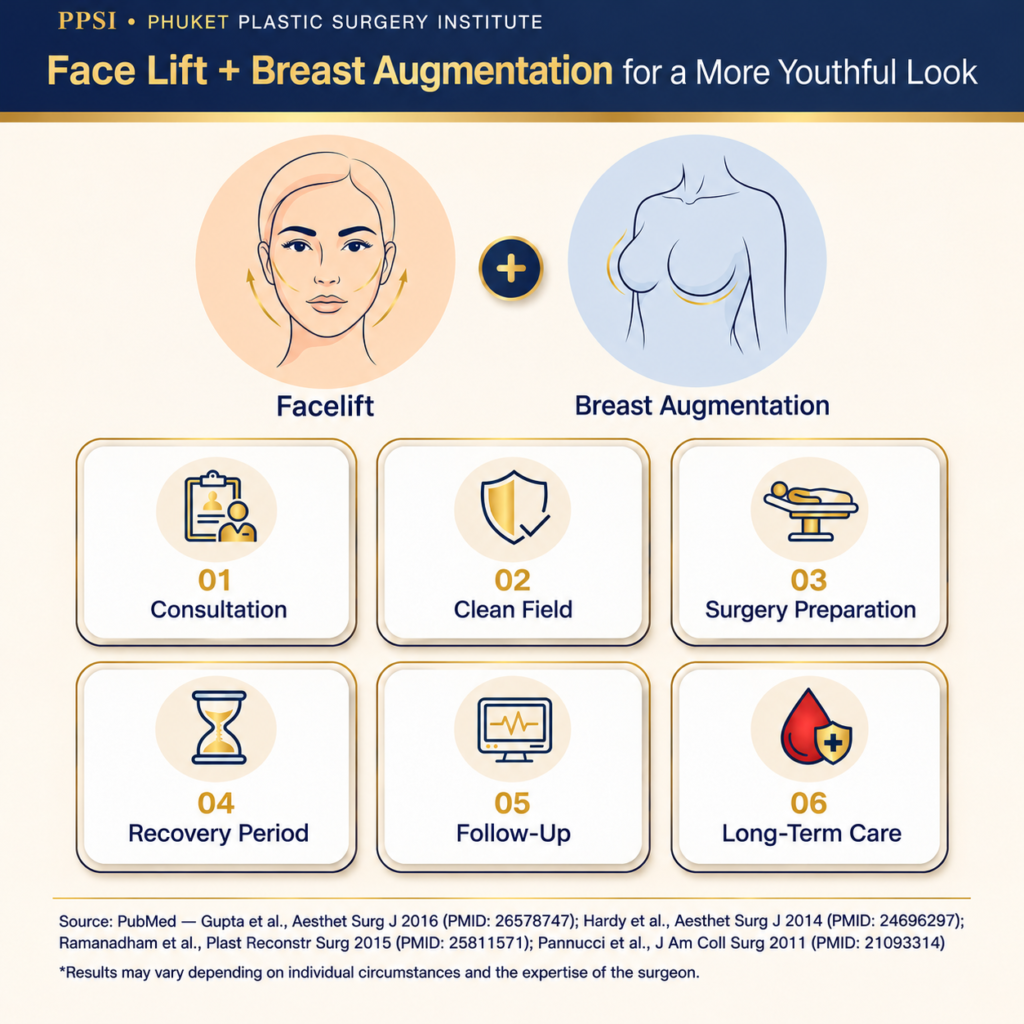
The end of the year is a time when many people want a fresh start for both their appearance and their confidence. PPSI therefore invites you to consider two transformations at once: a fresher, younger-looking face and a more proportionate figure—for those who can take only a limited leave from work, especially those traveling from abroad. A frequently asked question is: "Can a facelift and breast augmentation be done under a single anesthesia session, and how can it be done as safely as possible?"
The concept of single-stage combined surgery, using a facelift (rhytidectomy) together with breast augmentation as the primary example, covers surgical sequencing, patient positioning, anesthesia duration management, and a sample 14-day recovery plan in Phuket. All medical information is referenced from research in the PubMed database.
Why Combine a Facelift and Breast Augmentation in a Single Anesthesia Session
Single-stage combined surgery means planning for two or more procedures to take place under a single round of anesthesia, instead of separating them into two sessions weeks or months apart. The conceptual advantages are as follows:
Fewer repeat anesthesias: Preparation including fasting, physical examination, and recovery from anesthesia happens only once.
A single consolidated recovery period: One period of leave from work—suitable for patients who travel to undergo surgery and recover away from home.
Simultaneous results: The face and figure improve in the same timeframe, matching the needs of those who want both a youthful face and confidence in their figure.
Who Is Combined Surgery Suitable For
The decision depends on evaluation by the plastic surgeon and anesthesiologist. Factors that research indicates increase risk include:
Male sex: An independent risk factor for hematoma after facelift (relative risk 3.9).
BMI of 25 or higher: Associated with a higher rate of infection after facelift, and increasing BMI is associated with VTE risk.
Older age: Associated with a slightly increased VTE risk.
Smoking: An independent risk factor for surgical site infection (relative risk 1.61).
Patients with multiple risk factors may be advised to split the surgery into two sessions—a decision made for safety, not a service limitation.
Surgical Sequencing: Clean Field and Patient Positioning
Once the decision to combine procedures is made, the next question is "what comes first?" Sequencing is not fixed, but surgical teams generally consider the following principles:
1. Separate the surgical fields to keep them clean (Clean Field)
Facelift and breast augmentation are clearly distinct surgical areas. The team therefore prepares the skin, drapes sterilely, and organizes instruments separately for each site to reduce cross-contamination between sites. This matters because combined surgery increases the risk of infection after facelift, and infection around breast implants is a condition every team must rigorously prevent.
2. Minimize the number of position changes (Patient Positioning)
Both procedures are performed mainly in the supine position, but the details differ. Facelift requires turning the head to each side, while many breast augmentation techniques require adjusting the bed so the patient is in a semi-sitting position during surgery to check symmetry of the breasts. Good sequencing helps reduce body movement, reduce re-draping, and reduce non-operative time.
3. Blood pressure control and hemostasis for the face
Hematoma is the most common complication after facelift. A study of 1,089 facelift patients using a strict blood pressure control protocol, targeting systolic pressure no higher than 140 mmHg throughout surgery, found postoperative hematoma in only 0.9%, and 80% of those who developed hematoma had high blood pressure in the recovery room. In combined surgery, the team must therefore plan for facial wound closure, bleeding point inspection, and blood pressure control during emergence from anesthesia to proceed smoothly.
4. Schedule procedures requiring high precision when the team is at its most ready
Some surgeons choose to perform the more complex, time-consuming procedure first; others choose an order that minimizes position changes—depending on the technique used, the team's experience, and each patient's physical condition.
Anesthesia Time Management and Anesthesiologist Monitoring
The Anesthesiologist's Role
The anesthesiologist cares for the patient throughout surgery and emergence from anesthesia, with key responsibilities such as:
1. Assessing preoperative readiness, including underlying diseases and medications used.
2. Continuously monitoring vital signs and controlling blood pressure within target—important for reducing hematoma after facelift.
3. Working with the surgeon to assess thromboembolism risk using the Caprini Risk Assessment Model, whose accuracy has been validated in plastic surgery patients. Those with very high scores have a clearly elevated VTE risk if prophylaxis is not given, and the risk may extend beyond the first two weeks.
4. Planning VTE prevention, such as compression devices, early ambulation, and consideration of prophylactic medication according to risk level.
5. Planning pain control and reducing nausea and vomiting to speed recovery, in line with Enhanced Recovery After Surgery (ERAS) guidelines, which report that most aesthetic breast surgery patients return to daily activities faster than expected.
Can Eyelid Surgery Be Done at the Same Time?
Double eyelid surgery or blepharoplasty is an additional procedure some patients are interested in having with a facelift, so that the upper and lower face harmonize. However, every added procedure means longer operative time. The surgeon will consider individually whether it should be included in the same session or done separately later.
Sample 14-Day Recovery Plan in Phuket
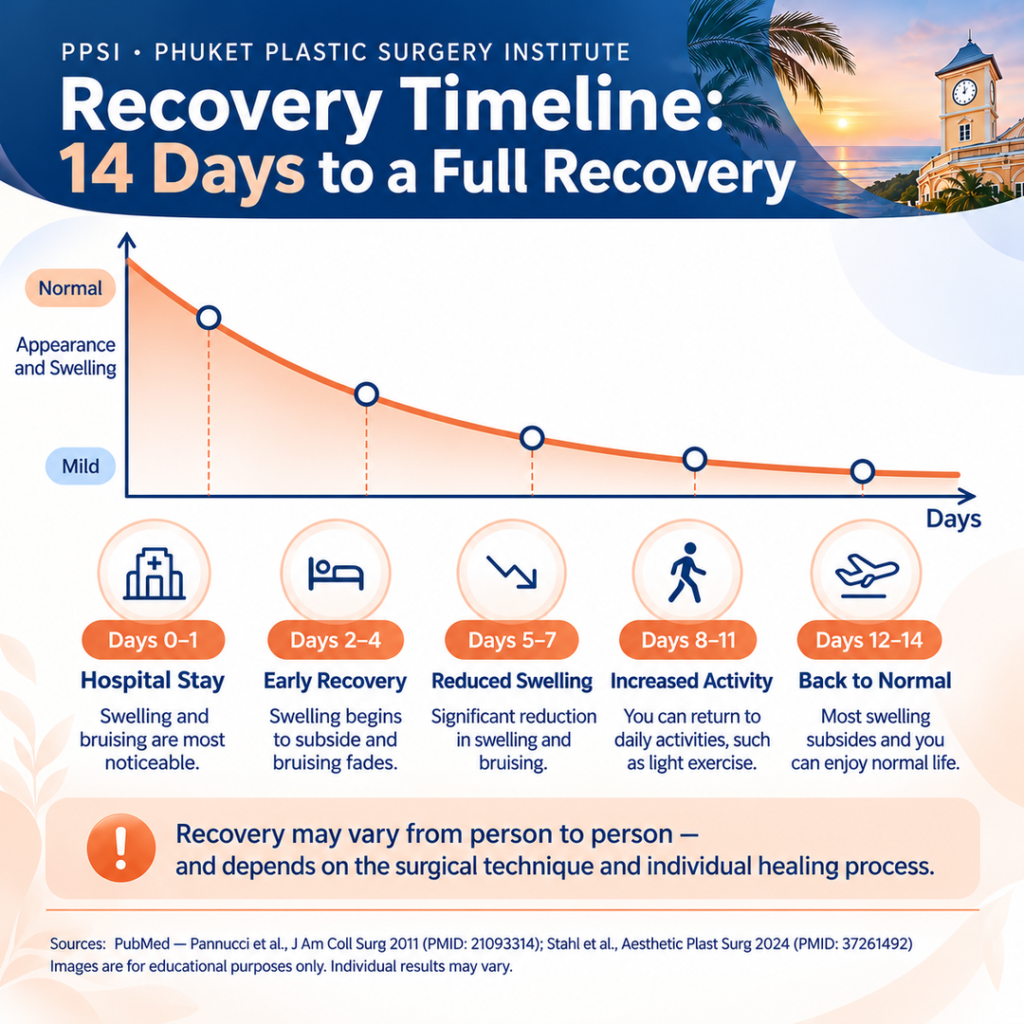
Phuket is a destination many choose both for surgery and recovery. From late year to early year the weather is relatively dry and suitable for rest. The table below is a sample recovery plan after facelift combined with breast augmentation; actual timing of each phase depends on the technique, wound healing, and the treating physician's advice.
During days 0–1, surgery takes place and the patient is closely monitored postoperatively, with the nursing team tracking vital signs, blood pressure, and pain.
During days 2–4, facial swelling and bruising are at their peak in the early period and the breasts feel tight; patients should sleep with the head elevated, walk gently and frequently, and wear the bra as prescribed by the physician.
During days 5–7, swelling begins to decrease and wounds are checked per appointment; patients should avoid heavy lifting, avoid strenuous exercise, and avoid strong sunlight on the wound area.
During days 8–11, patients are able to do more light activities, have wounds checked and sutures removed per appointment, can walk indoors, and must not swim until the physician permits.
During days 12–14, a pre-departure evaluation is performed, and patients receive continued home care instructions and plan remote follow-up.
The key point is to walk regularly to reduce clot risk, and not to travel long distances before the physician assesses that you are ready, because in high-risk patients some VTE events occur after the first two weeks.
How PPSI Cares for You
Phuket Plastic Surgery Institute (PPSI) emphasizes individualized assessment before deciding on combined surgery—from history taking, physical examination, and risk factor assessment to planning procedure sequencing and operative time together with the surgical and anesthesia teams. If assessment finds that separate surgeries would be safer, the team will advise you straightforwardly.
For patients traveling from other provinces or abroad, PPSI has accommodation packages with hotels so that the 14-day recovery is convenient, close to the medical team for scheduled follow-ups, and allows rest in Phuket's atmosphere. Package details can be inquired about directly with staff.
Frequently Asked Questions (FAQ)
When multiple areas are done at once, how does the physician sequence them?
Physicians prioritize safety. They begin by assessing whether the patient is suitable for combined surgery, then set total operative time within an appropriate range, because longer surgery is associated with increased complications. They then plan the sequence to minimize position changes, separate the sterile fields of the face and breasts, and plan blood pressure control to reduce hematoma after facelift. The exact sequence depends on the technique and each surgeon's decision.
Facelift and breast augmentation together—how many days of recovery?
Generally, PPSI recommends planning to stay in Phuket for about 14 days so the physician can follow up on wounds and assess readiness before travel. However, actual recovery time differs among individuals. ERAS guideline research found that most aesthetic breast surgery patients return to most daily activities within a few days, but facelift usually involves swelling and bruising that take longer to resolve. Returning to strenuous exercise or long-distance travel should wait until the physician permits.
Does combined surgery carry a higher risk of thromboembolism?
The risk is higher than a single procedure, but facial and breast procedures have the lowest VTE rates in data on over 129,007 patients. Physicians will assess individual risk with tools such as the Caprini Score and then choose appropriate preventive measures.
Can men have a facelift combined with other procedures?
It can be done in suitable patients, but data show that men have a higher risk of hematoma after facelift than women, so blood pressure must be controlled strictly and operative timing planned with particular care.
Must one quit smoking before surgery?
Yes, one should quit, because smoking is an independent risk factor for surgical site infection in aesthetic surgery. The duration of abstinence before and after surgery should be discussed with the treating physician.
A facelift combined with breast augmentation under a single anesthesia session is an option that allows both face and figure to change in one timeframe, reduces repeat anesthesia, and consolidates the recovery period. However, safety depends on patient selection, surgical sequencing, operative time control, blood pressure control, and systematic clot prevention. If you are considering a Double Transformation this year-end, consult a PPSI physician for individualized assessment and a plan suited to you.