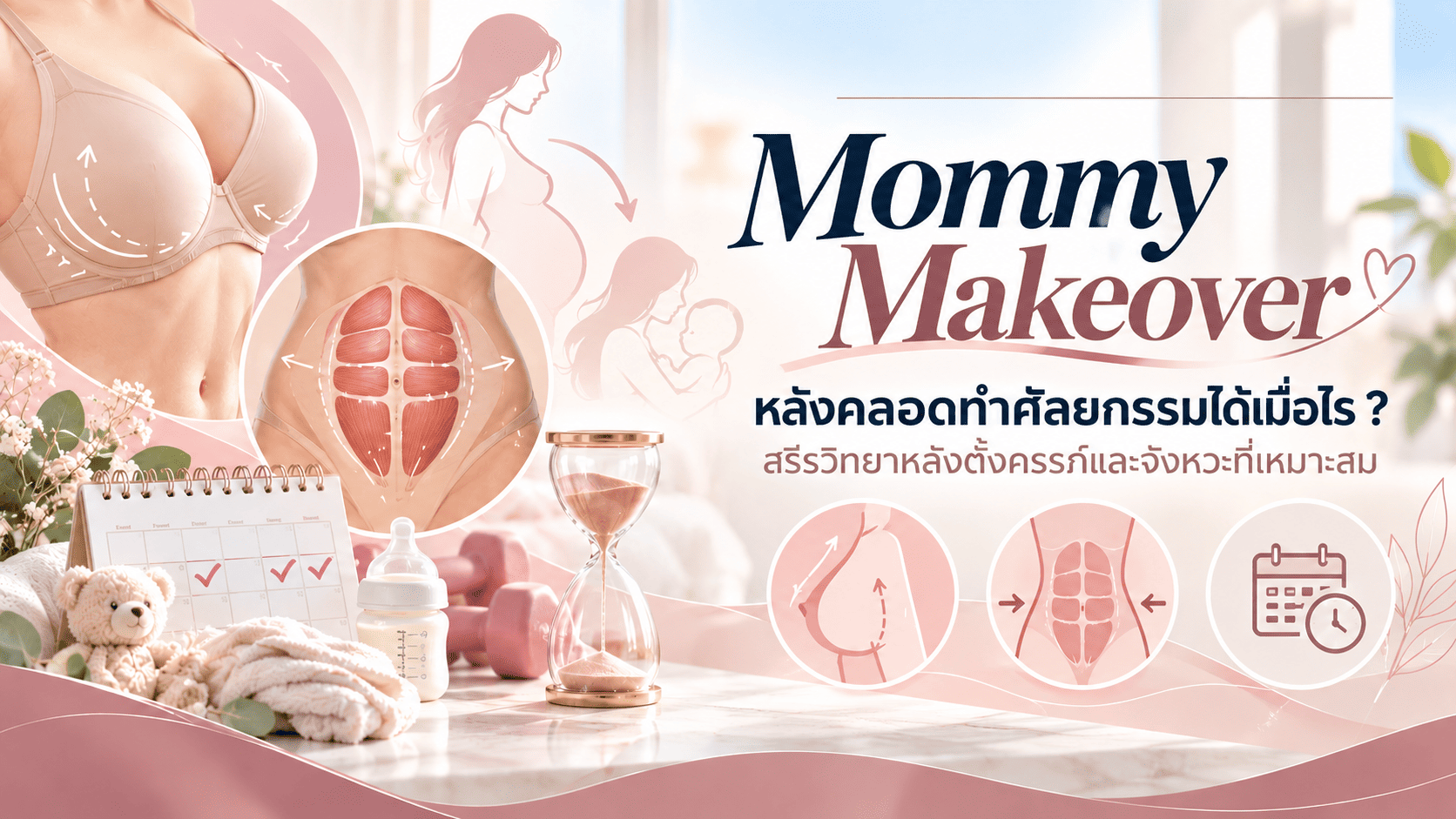
Motherhood brings about major changes in both life and the body. During the "Double Transformation" campaign this October, many mothers are beginning to seek their "second transformation"—restoring the shape of their breasts and abdomen to regain confidence ahead of the year-end festive season. Consequently, the most frequently asked question is not "what procedure should be done?" but rather "when can surgery be performed after childbirth?" and "at what point, when the body is truly ready, should a Mommy Makeover begin?"
This article explains the physiology of the body following pregnancy and after cessation of breastfeeding—from postpartum breast involution and diastasis recti to the criteria for weight stability, the effects of a subsequent pregnancy, and the concept of individualized planning for combined breast–abdominal surgery—with reference to research from the PubMed database.
What Happens to the Breasts and Abdomen After Pregnancy and Breastfeeding ?
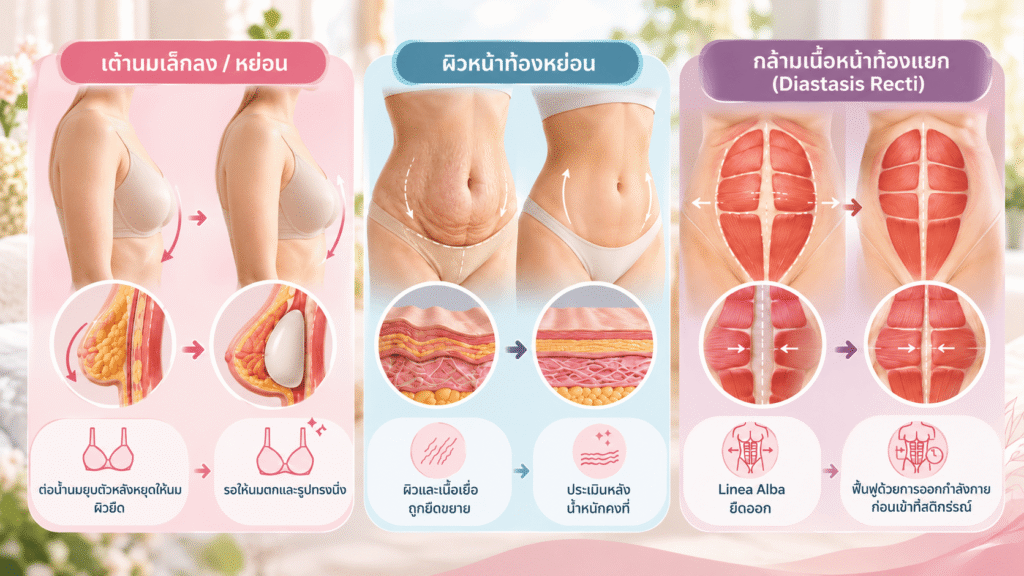
Postpartum Breast Involution
During pregnancy, multiple hormones stimulate the mammary glands to grow and branch into a network primed for milk production. Upon delivery and during breastfeeding, prolactin and oxytocin sustain milk synthesis. However, after breastfeeding ceases, the decline in prolactin secretion, together with signaling mediators within breast tissue, triggers the breakdown of a large number of mammary gland cells—a process known as "involution."
The observable result for mothers is that the breasts may become smaller and softer; the skin that was once stretched may not fully retract; and the nipple position may descend, resulting in apparent breast ptosis. Studies among patients consulting for breast surgery have found that most women who have previously been pregnant report undesirable changes in breast shape after pregnancy—some experiencing smaller breasts, others larger.
A concern shared by many mothers is whether "breastfeeding will make the breasts saggier." Research by Rinker et al. found that factors significantly associated with post-pregnancy breast ptosis included older age, higher body mass index (BMI), a greater number of pregnancies, a larger pre-pregnancy cup size, and smoking, whereas breastfeeding was not an independent risk factor for breast ptosis. Another study by the same group further found that a history of substantial weight loss was also a contributing risk factor. This information allows breastfeeding mothers to feel reassured.
Abdominal Skin and Diastasis Recti
The stretching of the skin and the midline fascial band (linea alba) during pregnancy causes the rectus abdominis muscles to separate. An observational follow-up study found that the inter-rectal distance and pelvic floor recovery can improve naturally over a period of 3 to 12 months postpartum. However, the severity of this condition varies directly with BMI and the number of pregnancies, which may lead to pelvic pain, urinary incontinence, or abdominal hernia.
Criteria for Weight Stability and Recommended Postpartum Timing
There is no single figure that applies to every mother; however, physiological principles point in the same direction—the body should be allowed to "settle" first, across three dimensions:
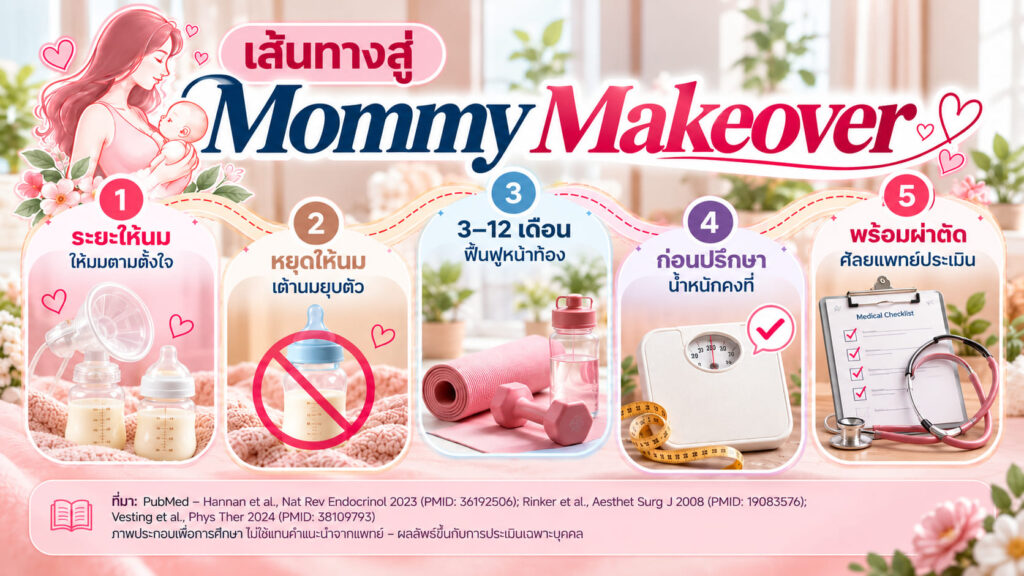
1. Breast stability — Breastfeeding has ceased, and sufficient time has been allowed for the process of mammary involution to occur until breast size and shape no longer change. Performing breast surgery while the tissue is still changing may lead to inaccurate assessment of implant size or mastopexy.
2. Natural abdominal recovery first — Because diastasis recti often improves during the first year postpartum, waiting and undertaking appropriate physical therapy or exercise will help the surgeon identify which areas genuinely cannot recover on their own and which require surgical repair of the muscle fascia combined with abdominoplasty.
Weight stability — Surgeons generally recommend that weight be close to target and remain stable for a period before surgery, because substantial postoperative weight change can lead to skin laxity or altered contour. A history of significant weight loss is itself associated with breast ptosis, while elevated BMI is associated with the severity of diastasis recti.
In addition, mothers should be in good physical and mental health, adequately rested, have assistance with childcare during the recovery period, and have no uncontrolled underlying medical conditions. The exact timing for each individual should be determined in consultation with the surgeon following physical examination.
The Effect of a Subsequent Pregnancy on Outcomes
A key question every woman should ask herself before undergoing a Mommy Makeover is: "Am I planning to have more children?" The medical rationale is as follows:
Breasts — The risk of breast ptosis increases with the number of pregnancies. Therefore, pregnancy following mastopexy or breast augmentation may alter breast shape once again.
Abdominal wall — A retrospective study of 117 mothers who sought abdominal wall repair found that the inter-rectal distance increased the most between the first and second pregnancies; thereafter, the degree of widening increased less, although in some cases it continued to worsen—particularly in women with twin pregnancies, large-for-gestational-age infants, or excessive gestational weight gain. The researchers concluded that these findings are useful for determining the timing of abdominal wall repair surgery.
Abdominoplasty — This is central to post-pregnancy body contouring. A subsequent pregnancy will re-stretch the skin and the repaired muscle fascia, potentially necessitating revision surgery in the future.
That said, these procedures do not preclude future pregnancy; however, if additional children are planned, consultation with a physician is advisable to determine whether certain procedures should be deferred or whether only less-affected interventions should be selected.
Individualized Mommy Makeover Planning
A Mommy Makeover is an individualized combination of surgical procedures (e.g., breast reshaping combined with abdominoplasty and liposuction) tailored to the patient's anatomy and goals.
Is It Safe to Perform the Procedures Simultaneously ?
Research by Matarasso and Smith confirms that combined breast surgery and abdominoplasty can be performed safely in appropriately healthy patients. The key precautions are careful management of operative time and prevention of venous thromboembolism (VTE).
Recommended Planning Steps
- Overall health assessment — underlying medical conditions, anemia, smoking history, and thromboembolic risk factors.
- Breast assessment — degree of ptosis, breast tissue volume, and skin quality, in order to select between augmentation, mastopexy, or both.
- Abdominal assessment — amount of excess skin and fat, degree of muscle separation, and associated symptoms such as back pain and urinary incontinence.
- Prioritization — some patients are suited to a single combined session, while others are better served by staging the procedures in two phases, depending on safety and operative time.
- Recovery planning — the period during which heavy lifting is prohibited, including lifting the child, so assistance at home should be arranged.
How PPSI Cares for You ?
At PPSI — Phuket Plastic Surgery Institute, every Mommy Makeover plan begins with listening to the mother's goals and an individualized assessment by our team of plastic surgeons—covering general health, time elapsed since childbirth or cessation of breastfeeding, weight stability, and plans for future children—in order to design surgery that is safe and truly suited to your body.
For mothers traveling from other provinces or from abroad, Phuket during the year-end period is in its tourist season, when the weather is relatively dry and conducive to relaxed recovery. Our team provides postoperative care guidance and schedules close follow-up appointments. Please note that individual results vary and cannot be guaranteed.
Frequently Asked Questions (FAQ)
Q : How many months after childbirth or cessation of breastfeeding can a Mommy Makeover be performed ?
A : There is no fixed figure; the key principle is to wait until the body has settled. This means breastfeeding has ceased and the breasts have undergone involution until their size no longer changes, and the abdomen has recovered naturally—research indicates that diastasis recti typically diminishes during the 3–12 months postpartum—and weight is stable and close to target.
Practical steps are:
1) Stop breastfeeding and observe breast shape.
2) Rehabilitate the abdominal muscles through low-impact exercise.
3) Maintain stable weight.
4) Schedule a consultation with a plastic surgeon for assessment and to determine timing appropriate for you.
Q : Can I Become Pregnant Again After the Procedure ?
A : Pregnancy remains safe. Breast and abdominal surgery does not prevent pregnancy; however, a subsequent pregnancy may alter the results, as the risk of breast ptosis increases with the number of pregnancies, and the abdominal wall may be stretched again—particularly in women with twin pregnancies or excessive weight gain—potentially requiring revision surgery in the future. Most surgeons therefore recommend undergoing a Mommy Makeover once family planning is complete. If you are still uncertain, consultation with a physician is advisable in order to select the most appropriate procedures.
Q : Does Prolonged Breastfeeding Genuinely Cause Greater Breast Ptosis ?
A : Based on the available evidence, it is not a major factor. Research has found that breastfeeding is not an independent risk factor for post-pregnancy breast ptosis. The factors more strongly associated are age, BMI, number of pregnancies, pre-pregnancy breast size, and smoking. Mothers may therefore breastfeed for as long as they intend, and plan for reshaping once breastfeeding has ceased.
Q : Is Combined Breast and Abdominal Surgery Riskier Than Staged Procedures ?
A : Simultaneous surgery is a common combination and can be performed safely in appropriately selected patients. The issues requiring careful planning are operative time and the prevention of thromboembolism. The surgeon will determine, based on the patient's health and the extent of surgery, whether to perform the procedures in a single session or in two stages.
References (PubMed)
Hannan FM, Elajnaf T, Vandenberg LN, et al. Hormonal regulation of mammary gland development and lactation. Nat Rev Endocrinol. 2023;19(1):46-61. doi:10.1038/s41574-022-00742-y. PMID: 36192506. https://pubmed.ncbi.nlm.nih.gov/36192506/
Rinker B, Veneracion M, Walsh CP. The effect of breastfeeding on breast aesthetics. Aesthet Surg J. 2008;28(5):534-7. doi:10.1016/j.asj.2008.07.004. PMID: 19083576. https://pubmed.ncbi.nlm.nih.gov/19083576/
Rinker B, Veneracion M, Walsh CP. Breast ptosis: causes and cure. Ann Plast Surg. 2010;64(5):579-84. doi:10.1097/SAP.0b013e3181c39377. PMID: 20354434. https://pubmed.ncbi.nlm.nih.gov/20354434/
Vesting S, Gutke A, Fagevik Olsén M, et al. The Impact of Exercising on Pelvic Symptom Severity, Pelvic Floor Muscle Strength, and Diastasis Recti Abdominis After Pregnancy: A Longitudinal Prospective Cohort Study. Phys Ther. 2024;104(4). doi:10.1093/ptj/pzad171. PMID: 38109793. https://pubmed.ncbi.nlm.nih.gov/38109793/
Sartori A, Tfaily A, Botteri E, et al. Rectus muscle diastasis in Italian women: determinants of disease severity, and associated disorders. Front Surg. 2024;11:1360207. doi:10.3389/fsurg.2024.1360207. PMID: 38529469. https://pubmed.ncbi.nlm.nih.gov/38529469/
Bruno A, Foti R. When Does Rectus Diastasis Worsen the Most? A Pregnancy-Order Analysis of Midline Fascial Failure. Aesthetic Plast Surg. 2026;50(15):6497-6511. doi:10.1007/s00266-026-05997-8. PMID: 42321447. https://pubmed.ncbi.nlm.nih.gov/42321447/
Matarasso A, Smith DM. Strategies for Aesthetic Reshaping of the Postpartum Patient. Plast Reconstr Surg. 2015;136(2):245-257. doi:10.1097/PRS.0000000000001410. PMID: 26218374. https://pubmed.ncbi.nlm.nih.gov/26218374/
Matarasso A, Smith DM. Combined breast surgery and abdominoplasty: strategies for success. Plast Reconstr Surg. 2015;135(5):849e-860e. doi:10.1097/PRS.0000000000001238. PMID: 25919267. https://pubmed.ncbi.nlm.nih.gov/25919267/