The year-end holiday season is a time when many people have a long weekend of about 4–5 days, often prompting the popular question: "Can we use this short break to refresh ourselves and look better?". This has sparked significant interest in "quick recovery plastic surgery" or "fast-healing procedures," especially among travelers vacationing in Phuket who need to be ready to return to work as usual.
Defining Minimally Invasive and "Fast Recovery" Criteria
Minimally invasive procedures refer to medical treatments with tiny incisions or no incisions at all, typically requiring only local anesthesia or light sedation and performed on a day-case basis, allowing patients to return to their accommodation on the same day. Non-invasive procedures, such as high-intensity focused ultrasound, involve no external wounds whatsoever.
Understanding "fast recovery" requires evaluating two key dimensions:
Social Downtime: The period during which swelling, bruising, or redness remains visible, making it inconvenient to attend social gatherings.
Physical Recovery: The period during which deep internal tissues repair themselves, which takes significantly longer than external skin healing.
A common misconception is assuming that once external bruising fades, the body has fully healed, even though deeper tissue layers still require time to recover. Therefore, planning procedures during a short vacation must balance both dimensions rather than relying solely on what appears in the mirror.
Procedures Categorized by Recovery Time
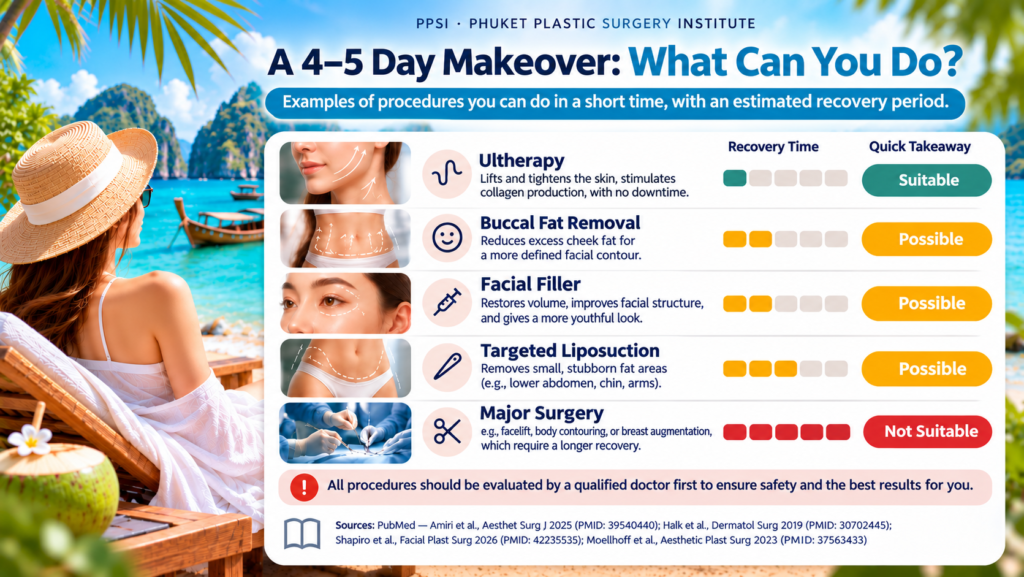
Non-Surgical Category: Ultherapy (Microfocused Ultrasound)
Microfocused Ultrasound (MFU), widely known as Ultherapy, is a technology that uses focused high-frequency sound waves to stimulate deep-skin tightening without surgical incisions.
Based on 42 clinical studies, the majority of patients demonstrated aesthetic improvements as evaluated by physicians. Common side effects included mild to moderate redness, swelling, bruising, and tenderness, with moderate pain during treatment
MFU yields favorable results in individuals with mild to moderate skin laxity, with other side effects being exceptionally rare. However, severe skin laxity or a body mass index (BMI) exceeding 30 are relative contraindications due to reduced efficacy. Thus, this procedure is ideal for short holidays, provided expectations match the actual degree of skin laxity.
Minor Procedure Category: Targeted Liposuction
Targeted liposuction over small areas using tumescent local anesthesia (injecting a large volume of anesthetic solution into the fat layer) can be performed as a day-case procedure.
Tumescent local anesthesia is considered the safest technique, particularly when general anesthesia is minimized or avoided, whereas higher risk factors stem from general anesthesia, intravenous sedation, or combining multiple procedures simultaneously. This evidence supports the principle that "the smaller and simpler the procedure, the more suitable it is for a short trip". Nevertheless, patients must wear compression garments and allow time for swelling and bruising to resolve.
Minor Procedure Category: Buccal Fat Reduction
Buccal fat reduction is performed via tiny intraoral incisions, leaving no visible external scarring. A 2026 systematic review of 10 studies (1,123 patients total) reported high satisfaction levels, with most complications being minor and an overall complication rate of approximately 4.2%.
However, long-term follow-up data remains limited, and some studies report that faces may appear hollow over time. Physicians must carefully evaluate facial structure and age, as facial fat naturally diminishes with aging.
Minor Procedure Category: Facial Fat Grafting
Small-volume autologous fat grafting to restore facial fullness typically causes initial swelling. Although generally considered safe, rare but severe complications can occur, such as arterial embolism leading to vision loss or stroke, particularly during injections in the glabella, temples, and forehead. Therefore, this procedure requires deep anatomical knowledge of facial vasculature by expert surgeons and should never be viewed as merely a "minor job".
Procedures Unsuitable for Short Vacations
Major surgeries—such as facelifts, breast augmentation, or tummy tucks—require post-operative monitoring and recovery periods exceeding a 4–5 day trip. If you wish to undergo these procedures, you should plan a longer stay in Phuket as recommended by your surgeon.
Minimum Duration Before Flying Home and Acceleration Risks
Both surgery and long-distance air travel are risk factors for Venous Thromboembolism (VTE). A 2025 systematic review of 7 retrospective studies (24,975 patients) found no statistically significant increase in post-operative VTE risk associated with air travel. However, researchers noted that confounding factors were not fully controlled, meaning this data does not imply that patients "can fly back immediately in all cases".
In plastic surgery, risk assessment tools like the Caprini Risk Assessment Model help accurately categorize patients' VTE risk levels. For high-risk groups, VTE risks are not limited to the immediate post-operative period but frequently occur between days 15 and 60 post-surgery in over half of cases. Consequently, a Fit-to-Fly Assessment must comprehensively evaluate procedure type, flight duration, and individual risk factors such as blood clot history, hormone use, or body weight.
Furthermore, rushing back too quickly places patients far from their surgical team during potential complication windows. Studies from Ireland report patients returning from cosmetic surgery abroad who experienced complications—such as wound dehiscence, infection, seroma, or hematoma—requiring additional medical care in their home country. Allocating time for post-operative follow-up before flying and maintaining communication channels after returning home are essential steps to mitigate these risks.
Practical Travel Recommendations (Always confirm with your attending physician):
- Walk around or flex your ankles periodically during the flight.
- Drink adequate clean water and avoid alcoholic beverages.
- Wear compression stockings or garments as recommended by your surgeon.
- Always carry your medical summary, medication list, and travel clearance documents.
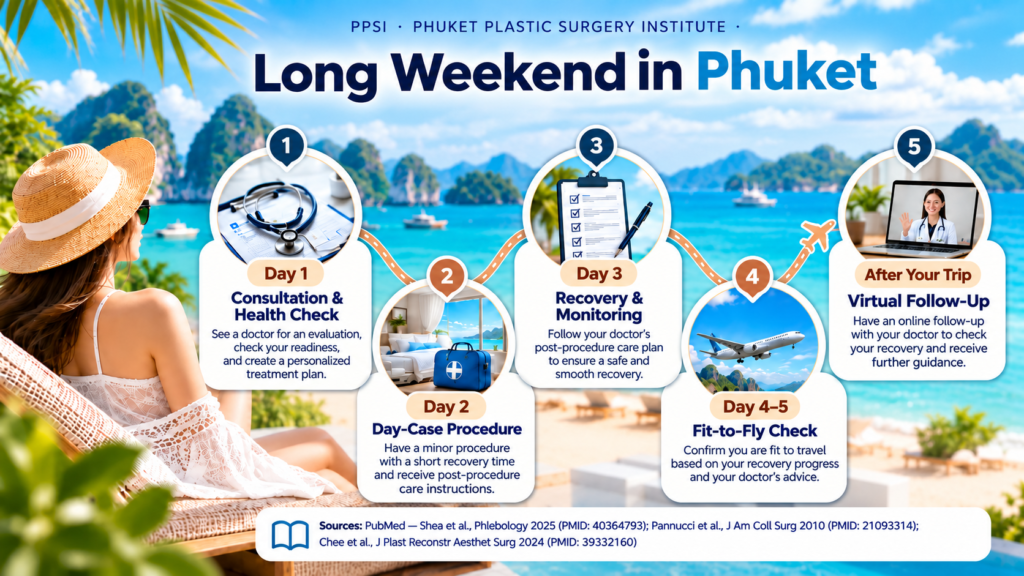
Sample 4–5 Day Timeline in Phuket
(Note: This sample timeline is suitable only for non-surgical or minor procedures and can be adjusted based on medical evaluation)
Day 1 Consultation & Physical Exam: Consult surgeon, assess suitability, take medical history, and evaluate VTE risk.
Day 2 Procedure (Day-Case): Undergo procedure, return to accommodation, apply cold compress, and follow post-care instructions.
Day 3 First Follow-up: Initial follow-up, inspect wounds, check swelling, and adjust care accordingly.
Days 4–5 Follow-up & Fit-to-Fly Assessment: Monitor symptoms, assess pre-flight readiness (Fit-to-Fly), and receive medical summary documents.
After Return Virtual Follow-up: Send assessment photos and maintain ongoing communication with the medical team online.
Key Takeaway: Avoid scheduling procedures on the final day before flying to allow at least 1–2 days of observation, and utilize remote post-operative tracking after returning home so your medical team can continuously monitor recovery.
How PPSI Cares for You
At Phuket Plastic Surgery Institute (PPSI), planning a Long Weekend Makeover program begins with a personalized consultation and evaluation by board-certified plastic surgeons. Our team helps select procedures aligned with your goals, available time, and travel safety. If your desired procedure is unsuitable for a short trip, we provide transparent recommendations and help plan safer alternatives.
Vacationing in Phuket allows you to recover in a relaxing environment alongside close monitoring at our institute. Even after returning to your home country, you can enjoy peace of mind through our remote symptom tracking system with our medical team at any time.
Undergoing quick recovery plastic surgery during a short holiday is achievable if you choose appropriate procedures, understand the difference between Social Downtime and Physical Recovery, and properly plan post-operative follow-ups before flying back. Consult with PPSI physicians for a personalized evaluation to design a care plan that balances your desired results with maximum safety.
Note: This article is provided for general educational purposes only and cannot replace diagnosis or advice from a physician. Treatment and results depend on individual evaluation.
Frequently Asked Questions (FAQ)
Q: What procedures can be done during a 4–5 day holiday?
A: 4–5 day holiday is ideal for non-surgical procedures like Microfocused Ultrasound (Ultherapy), which causes only temporary redness or swelling, or minor procedures such as targeted liposuction under tumescent anesthesia or buccal fat reduction in select cases. The process involves: 1) Advance online consultation, 2) Initial evaluation on Day 1, 3) Procedure early in the trip, and 4) Follow-up and Fit-to-Fly assessment before flying. Major surgeries are not suitable for such short timeframes.
Q: Which procedures allow the fastest flight back?
A: Non-invasive procedures without wounds or general anesthesia, such as Microfocused Ultrasound, generally allow the fastest return travel because side effects are mild and temporary. For procedures with incisions or sedation, individual VTE risk must be evaluated to determine an appropriate travel date with your plastic surgeon.
Q: Can multiple procedures be performed together in one trip?
A: It is possible in certain cases, but requires careful consideration as combining multiple procedures may increase complication risks. For short trips, selecting fewer, targeted procedures is usually the safer choice.
References (PubMed)
[1]Amiri M, Ajasllari G, Llane A, et al. Microfocused Ultrasound With Visualization (MFU-V) Effectiveness and Safety: A Systematic Review and Meta-Analysis. Aesthet Surg J. 2025;45(3):NP86-NP94. doi:10.1093/asj/sjae228. PMID: 39540440. https://pubmed.ncbi.nlm.nih.gov/39540440/
[2]Contini M, Hollander MHJ, Vissink A, et al. A Systematic Review of the Efficacy of Microfocused Ultrasound for Facial Skin Tightening. Int J Environ Res Public Health. 2023;20(2):1522. doi:10.3390/ijerph20021522. PMID: 36674277. https://pubmed.ncbi.nlm.nih.gov/36674277/
[3]Halk AB, Habbema L, Genders RE, et al. Safety Studies in the Field of Liposuction: A Systematic Review. Dermatol Surg. 2019;45(2):171-182. doi:10.1097/DSS.0000000000001707. PMID: 30702445. https://pubmed.ncbi.nlm.nih.gov/30702445/
[4]Shapiro J, Zgardau A, Pundkay G, et al. Aesthetic Outcomes, Complications, and Reported Long-Term Effects of Buccal Fat Pad Reduction: A Systematic Review. Facial Plast Surg. 2026. doi:10.1055/a-2875-0465. PMID: 42235535. https://pubmed.ncbi.nlm.nih.gov/42235535/
[5]Moellhoff N, Kuhlmann C, Frank K, et al. Arterial Embolism After Facial Fat Grafting: A Systematic Literature Review. Aesthetic Plast Surg. 2023;47(6):2771-2787. doi:10.1007/s00266-023-03511-y. PMID: 37563433. https://pubmed.ncbi.nlm.nih.gov/37563433/
[6]Shea J, Ghosh A, Turner BR, et al. A systematic review and meta-analysis of venous thromboembolism risk in surgical patients with recent air travel. Phlebology. 2025;41(1):5-14. doi:10.1177/02683555251342912. PMID: 40364793. https://pubmed.ncbi.nlm.nih.gov/40364793/
[7]Pannucci CJ, Bailey SH, Dreszer G, et al. Validation of the Caprini risk assessment model in plastic and reconstructive surgery patients. J Am Coll Surg. 2010;212(1):105-12. doi:10.1016/j.jamcollsurg.2010.08.018. PMID: 21093314. https://pubmed.ncbi.nlm.nih.gov/21093314/
[8]Chee SY, Sheil F, Keane A, et al. Impact of aesthetic surgery performed abroad on the Irish healthcare system. J Plast Reconstr Aesthet Surg. 2024;98:339-341. doi:10.1016/j.bjps.2024.09.014. PMID: 39332160. https://pubmed.ncbi.nlm.nih.gov/39332160/