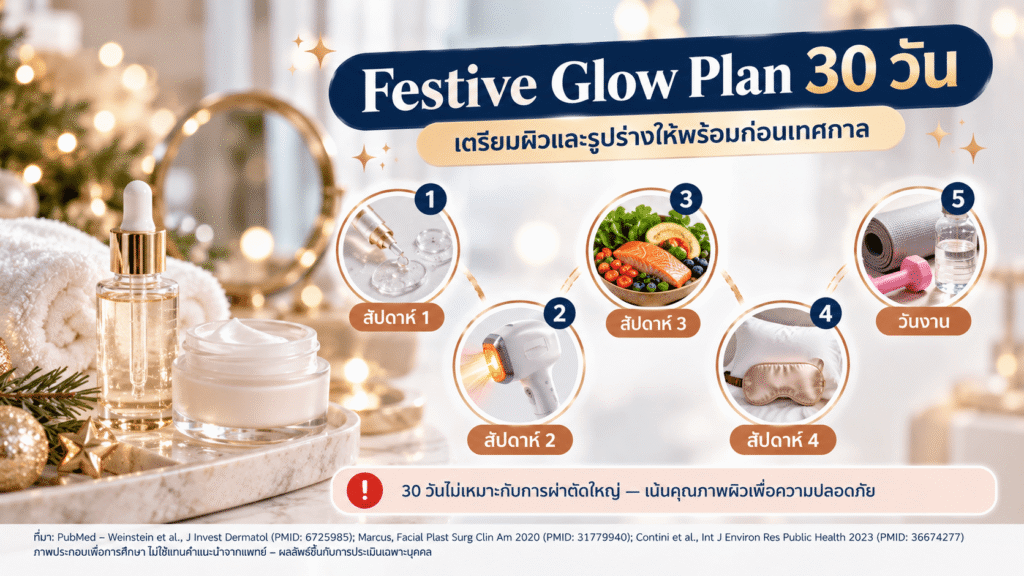
The final quarter of the year includes company parties, Christmas, and New Year countdown events. Many people wish to have skin that appears radiant, hydrated, and luminous in photographs. If approximately one month remains, skin care should be planned appropriately to reduce the risk of erythema, edema, or complications before the important event.
The Festive Glow Plan is a skin-quality care plan, not a surgical plan, because 30 days is a short period for major procedures requiring recovery. This article covers the skin cell turnover cycle, a weekly plan, treatment sequencing—such as low-downtime lasers, intravenous vitamin administration when indicated, home care, and precautions—to prepare the skin safely before an event.
The Principle of the Skin Cycle: Why Preparation Should Begin Approximately 30 Days Before the Festive Period
The epidermis continuously produces new cells from the basal layer. Cells migrate upward to the superficial layers, become the stratum corneum, and are eventually shed. This process is termed the skin cell turnover cycle. Although aesthetic practice often refers to a cycle of approximately 28 days, classic studies in healthy adults have estimated the mean turnover time of the entire epidermis at approximately 39 days. Actual duration varies according to the individual and the skin region.
Changes resulting from skin care require several weeks to become visibly apparent in the superficial skin layers. Beginning approximately 30 days before the event therefore represents a minimum timeframe that allows the skin to undergo cell turnover and to have time to recover from treatments. If 8–12 weeks are available, planning is more flexible.
Dullness and uneven skin tone in adults may be associated with intrinsic factors and cumulative sun exposure (photoaging). Consistent use of sunscreen helps prevent skin deterioration to some extent. Therefore, a good plan should include photoprotection and basic skin care throughout the 30 days, rather than focusing solely on performing numerous treatments.
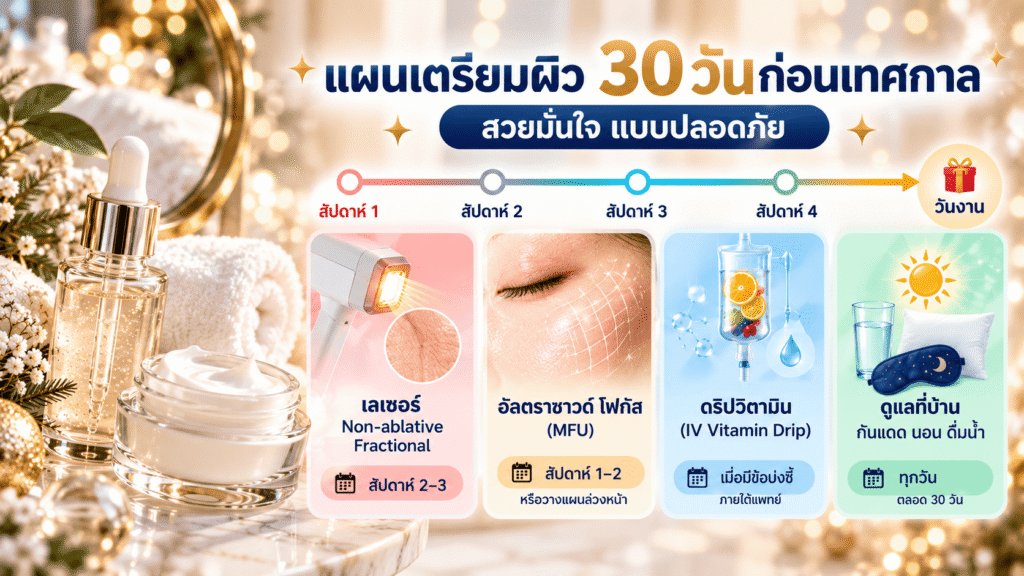
Weekly Plan: Assessment → Treatment → Recovery
Treatment sequencing and downtime planning should schedule interventions that may irritate the skin earlier in the plan, with the final week reserved for recovery.
Week 1: Skin Assessment and Planning
Consult a physician to assess dullness, melasma and freckles, pores, hydration, laxity, medication allergy history, and history of hypertrophic scarring.
Review currently used products, reduce potentially irritating agents, and initiate daily sunscreen use.
Confirm the event date to determine the appropriate timing and the last suitable date for performing procedures.
If intravenous vitamin drips are of interest, obtain a history and assess the necessity beforehand.
Weeks 2–3: Quality-Focused Skin Treatments With Low Downtime
This period is suitable for considering energy-based devices according to physician assessment. Non-ablative fractional lasers are designed to deliver energy in small zones with intervening normal skin, thereby promoting faster skin recovery and reducing downtime compared with methods that produce more extensive skin damage.
In some individuals with mild to moderate skin laxity, physicians may consider microfocused ultrasound (MFU), such as Ultherapy. Lifting and tightening effects appear gradually; according to academic literature, effects have been observed at 90 days and may continue to develop for approximately one year. Common adverse effects include transient erythema, edema, and pain during the procedure. If performed within 30 days before the event, it should therefore be regarded as long-term care rather than as an intervention expected to achieve full effects by the event date.
Week 4: Recovery and Avoidance of New Procedures
The final week should allow the skin to rest. Do not initiate treatments that have never been performed or procedures that may cause erythema, edema, peeling, or bruising. Emphasis should be placed on increasing hydration, using sunscreen, obtaining adequate sleep, and using familiar products. Integrate IV drip, Ultherapy, skin treatments, and home self-care.
IV Vitamin Drip: Use With Understanding
Intravenous administration of vitamins and minerals has a role in certain medical conditions, such as malabsorption causing severe vitamin deficiency. However, an article in the Drug and Therapeutics Bulletin states that there is no high-quality evidence that high-dose intravenous vitamins are necessary or beneficial for health in individuals who are not deficient in vitamins or who do not have specific conditions, and excessive intake of some vitamins may be harmful. Therefore, administration should be performed only by appropriately qualified medical personnel. Regarding glutathione, which is commonly used with the aim of skin brightening, an article on systemic skin-lightening treatments does not recommend intravenous glutathione for skin whitening because of the risk of adverse effects [5]. Individuals interested in vitamin drips should consult a physician, undergo assessment for nutrient deficiency and risk factors, and select an approach supported by medical rationale rather than choosing according to trends.
Diet and Nutrients for the Skin
Vitamins, carotenoids, and plant-derived antioxidants from fruits and vegetables have attracted interest as factors associated with skin aging. In practice, consuming a varied diet, including fruits and vegetables of multiple colors, and obtaining adequate protein constitute a safer and more sustainable foundation than relying solely on dietary supplements.
Sleep
Experimental research published in BMJ found that after sleep deprivation, participants’ faces were rated as appearing less healthy, more tired, and less attractive compared with after normal sleep. Obtaining adequate sleep, particularly in the week before the event, is therefore as important as undergoing treatments.
Photoprotection
A randomized study in Australia found that the group using broad-spectrum sunscreen daily showed no measurable increase in skin aging over 4.5 years and had approximately 24% less skin aging than the group using sunscreen on a discretionary basis. In high-sun-exposure areas such as Phuket, sunscreen should be applied daily and reapplied when outdoors, together with the use of a hat and sunglasses, particularly after laser treatment, when the skin may be more photosensitive.
Hydration
Drink sufficient water according to the body’s requirements, especially in hot and humid weather or during outdoor activities. Use moisturizers appropriate for the skin condition and reduce alcohol consumption before the event.
Precautions: Avoid Performing New Procedures Too Close to the Event
The core principle of the Festive Glow Plan is “avoid if possible; avoid beforehand” with respect to interventions that may increase the risk of complications before the event. The main principles are as follows:
Do not undergo surgery or major procedures within 30 days before the event, because time is required for edema resolution, wound healing, and follow-up. If surgery is of interest, it should be planned after the festive period or several months in advance.
Do not trial new products or interventions in the final week, because treatments, products, or substances to which the skin has never been exposed may cause irritation or allergy.
Avoid lasers with prolonged downtime, such as fully ablative resurfacing lasers. In short-term plans, physicians may select technologies designed to reduce downtime instead.
Substances administered intravenously should undergo assessment of necessity and safety, particularly formulas used for skin whitening.
Individuals with specific conditions, such as melasma, sensitive skin, or a history of post-inflammatory hyperpigmentation, should have the plan adjusted cautiously by a physician.
This plan is a general guideline. The suitability of each treatment depends on individualized assessment by a qualified physician.
Appropriate skin preparation before the New Year within 30 days involves respecting the natural rhythm of the skin: beginning with physician assessment, selecting quality-focused skin treatments with low downtime early in the plan, using vitamin drips only when indicated, and reserving the final week for recovery, together with sunscreen use, sleep, and adequate hydration. For a plan suited to individual skin conditions and the event date, consultation with a PPSI physician is recommended for individualized assessment.
How Does PPSI Provide Care?
At PPSI (Phuket Plastic Surgery Institute), pre-event skin care begins with a safe plan. Physicians assess skin condition, health history, and the event date in order to select appropriate quality-focused skin treatments, sequence them to allow sufficient recovery time, and recommend waiting if any procedure is not suitable within the 30-day timeframe.
For individuals seeking facial or body contouring through surgery, the surgical team will assist in planning at a more appropriate time, such as after the festive period, so that adequate recovery time is available.
Frequently Asked Questions (FAQ)