Deciding to reshape your body through liposuction especially in October, a period many consider the 'Golden Timeline' for getting your figure ready before the year-end festive season, whether for November's appreciation parties or New Year's celebrations is a beauty plan that requires a thorough understanding of the body's recovery process.
However, the most common questions that cause anxiety for patients after surgery are: 'Why does the body look more swollen after liposuction than before?' and 'How many days does it take for the swelling to subside?'
These concerns are natural, since liposuction results don't appear immediately after surgery. This article compiles academic evidence and medical research from the PubMed database to explain the mechanisms of tissue recovery, compare liposuction technologies, and help you plan your recovery time accurately with peace of mind and safety.
Key Takeaways
Swelling is a normal reaction of the body: it results from the natural inflammatory process of wound repair, together with temporary disruption of small lymphatic vessels in the fat layer.
Tissue recovery follows four stages: Hemostasis → Inflammation → Proliferation → Remodeling, which takes several consecutive months before the tissue fully settles.
Facts about VASER: This ultrasound-energy innovation stands out for its safety profile, helping reduce blood loss and surgeon fatigue. However, long-term medical evidence still indicates that its skin-tightening efficacy is not significantly different from traditional liposuction in patients with significantly loose skin.
Low complication rate: Liposuction performed by specialist plastic surgeons is highly safe, with a meta-analysis finding an overall complication rate of approximately 12%, most of which are mild, such as skin irregularity or seroma.
Wearing compression garments and manual lymphatic drainage (MLD): These play an important role in helping reduce swelling, prevent seroma, and help the skin adhere to the new contour more quickly.
The mechanism of swelling after liposuction: Why does the body look more swollen after surgery ?
Liposuction involves inserting a small suction tube (cannula) through a small incision beneath the skin, then moving the tube back and forth to separate and suction out fat cells. Although the visible external wound is only a few millimeters long, numerous small tunnel-like cavities are created in the subcutaneous fat layer. The body therefore perceives and responds to this condition in the same way as deep tissue injury.
1. Natural Inflammatory Response
The body's wound-healing process proceeds in sequential stages. It begins with natural hemostasis, then enters the Inflammatory Phase, during which immune cells are dispatched to clean and repair the injured area. Blood vessels in that region dilate, and fluid and proteins leak from the vessels into surrounding tissue, causing the treated area to become swollen, tight, and bruised in the early period. This is a normal biological response, not a sign of surgical error.
2. Impact on the Lymphatic System (Lymphatic Disruption)
The lymphatic system's primary function is to circulate and drain excess fluid from tissues. Systematic medical literature indicates that body-contouring procedures such as liposuction and abdominoplasty often disrupt the network of small lymphatic vessels in the fat layer, temporarily slowing fluid drainage and causing fluid accumulation in the tissue. Swelling after liposuction therefore subsides gradually and progressively—it does not disappear immediately.
3. Individual Factors Affecting Swelling Resolution Time
The speed of each person's recovery varies significantly, depending on various factors, including:
- Health and nutritional status: tissue oxygen levels, age, stress, underlying diseases (e.g., diabetes), certain medications, and the patient's nutrition
- Lifestyle behaviors: smoking and alcohol consumption, which directly affect blood vessels and wound healing
- Fat volume and body mass index (BMI): A medical study of 117 patients who underwent VASER liposuction found that patients with a BMI greater than 25 kg/m² were more likely to experience bruising, blood clots, or uneven skin contraction than those with normal weight. Pre-surgical body preparation and health care are therefore extremely important.
Academic Comparison: Traditional Liposuction (Tumescent SAL) vs. VASER (UAL)
Working Principles and Key Features of Each Technique
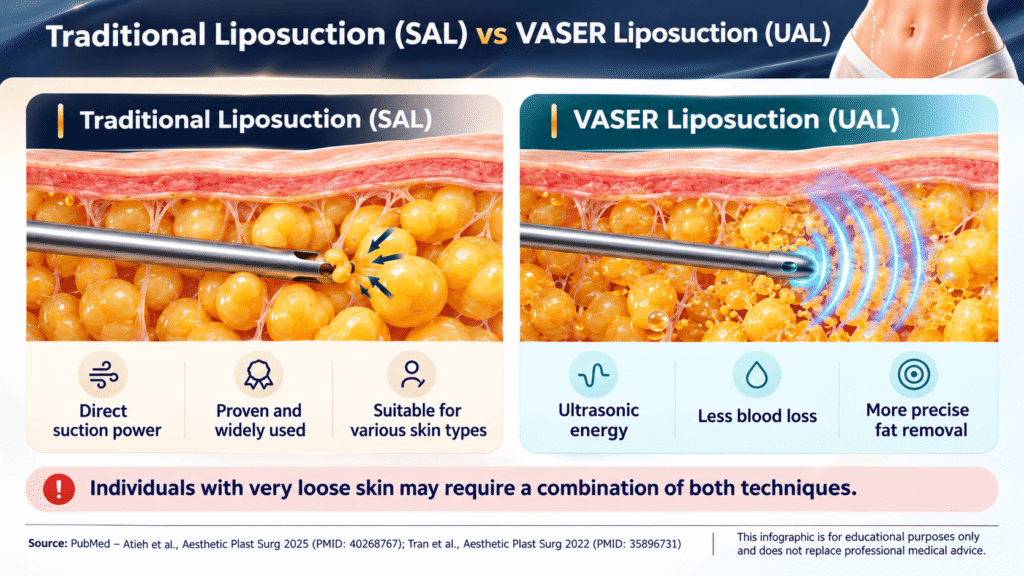
Tumescent Liposuction (Suction-Assisted Lipectomy: SAL)
- Mechanism: The surgeon pre-injects tumescent solution (wetting solution) into the fat layer to swell the fat cells, constrict blood vessels, reduce blood loss, and relieve pain (e.g., in a reported VASER patient group of 261 cases, an average of approximately 2,840 mL of solution was used per patient). Fat is then removed by vacuum suction through a cannula.
- Key features: This is the gold-standard technique—widely used and the foundation of all types of liposuction.
VASER Liposuction (Ultrasound-Assisted Liposuction: third-generation UAL)
- Mechanism: Emits high-frequency ultrasound energy to break down fat cell membranes, liquefying them before suction removal.
- Key features: Helps reduce the surgeon's physical effort in separating tissue planes. Medical reports show that VASER accounts for approximately 20% of all liposuction procedures, with notable advantages in safety, fat-dissolving efficacy, and a reduced rate of post-operative anemia.
Skin Retraction
The issue of skin contraction and tightening after VASER is a topic of considerable interest. A follow-up study of 261 VASER patients (783 treatment areas in total) over at least 6 months reported an overall complication rate of only 4.6% (skin irregularity 1.9% and seroma 0.8%), with the researchers noting that VASER allows precise management of superficial fat and helps promote skin tightening.
However, an academic review compiling 5 direct comparative studies between UAL and SAL concluded that there is still insufficient long-term medical evidence to confirm that VASER delivers significantly superior skin-tightening outcomes compared with traditional methods. Surgeons therefore caution that VASER should not be used as a substitute for skin excision surgery in patients with significant skin laxity.
An In-Depth Look at the 3 Stages of Tissue Recovery: From Swelling and Bruising to a Settled Final Shape
The wound-healing process of subcutaneous tissue proceeds continuously and in overlapping stages, with the following recovery sequence:
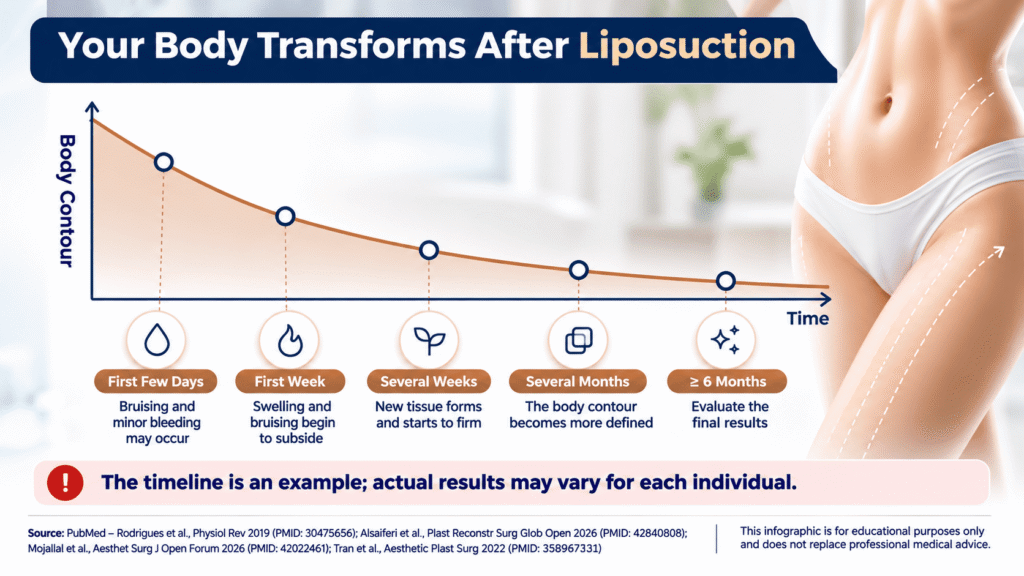
Inflammatory Phase — Day 1 to Week 1: Swelling, bruising, and tightness are at their peak, and fluid may leak from the wound.
Proliferative Phase — Week 2 to Week 6: New capillaries and collagen fibers are formed; edema decreases, but the area may feel temporarily hard and firm.
Remodeling Phase — Month 3 to 6 and beyond: Collagen is reorganized, tissue softens, and the new proportions and contour become clearly and fully apparent.
1. Inflammatory Phase: The Initial Period After Surgery (Day 1 – Week 1)
This is when the body responds fully to the injury. Patients will feel tightness, swelling, and clearly visible bruising; bloody saline may seep from the small incisions during the first 1–2 days. Strictly wearing compression garments as instructed by the surgeon is essential during this stage. Compression garments have been used medically for over half a century to apply pressure to the fat cavity, reduce lymphatic fluid accumulation, relieve pain, and help the skin layer adhere to the new contour.
2. Proliferative Phase: Wound Healing (Week 2 – 6)
The body begins forming new capillaries and collagen fibers within the tunnel cavities beneath the skin. Edema gradually and continuously decreases, but patients may begin to feel firm lumps or slight numbness in the liposuctioned area—a natural temporary fibrosis process.
Studies indicate that manual lymphatic drainage (MLD) performed by specialists, started during days 2–5 after surgery for 6–12 sessions, can effectively reduce swelling during this stage. In addition, a study of a new compression garment design featuring silicone strips for dynamic lymphatic drainage, with follow-up at days 7, 15, 30, and 60, found that it helped reduce swelling even faster.
3. Remodeling Phase: Full Settling (Month 3 – 6 and beyond)
Collagen fibers beneath the skin are broken down and reorganized into an orderly arrangement. Previously firm tissue gradually softens, and the skin contracts smoothly to fit the new contour. The true shape after liposuction becomes most clearly apparent during this stage, which is why most research recommends following up on results at least 6 months or more after surgery.
Recognizing Abnormal Symptoms and Complications That Require Medical Attention
A medical analysis compiling 60 studies involving 21,776 cosmetic liposuction patients found an overall complication rate of approximately 12%, with each type of complication being uncommon and occurring in the following proportions:
Common Complications That Require Care
- Seroma: Found in approximately 2% of cases; caused by fluid accumulation beneath the skin, appearing as a raised lump that feels fluid-filled when pressed. If it does not resolve on its own, the doctor may consider drainage.
- Contour Irregularity: Found in approximately 2% of cases. In the early period, it may result from uneven swelling, so it is advisable to wait until the remodeling phase has passed before evaluating the result. However, if it persists after several months, a consultation with the plastic surgeon is recommended to plan correction.
Danger Signs and Emergency Symptoms
- Signs of infection: Severely increasing pain, swelling, redness, warmth, high fever, or pus discharging from the wound—contact the operating plastic surgeon immediately.
- Respiratory and cardiovascular emergencies: If you experience difficulty breathing, chest tightness, or swelling and pain in only one leg (a risk sign of deep vein thrombosis), go to an emergency hospital for treatment immediately.
Self-Care Guidelines After Liposuction for Safe Recovery
- Wear compression garments strictly: Wear them for the duration and in the style prescribed by the surgeon; do not remove or change the garment type on your own without consulting the doctor.
- Move around and take short walks: Gentle walking as advised by the doctor helps stimulate blood circulation, prevent deep vein thrombosis, and drink sufficient clean water.
- Avoid smoking and alcohol: Nicotine and alcohol cause blood vessels to constrict and severely interfere with the wound-healing process.
- Consult the doctor before starting lymphatic drainage massage: To determine the appropriate timing, frequency, and correct technique, performed by a trained professional.
International-Standard Personalized Care at PPSI (Phuket Plastic Surgery Institute)
At Phuket Plastic Surgery Institute (PPSI), liposuction begins with a detailed structural assessment by specialist plastic surgeons—covering skin quality and elasticity, fat volume and location, body mass index (BMI), and overall health—in order to select the most suitable technique, whether Tumescent SAL, VASER, or combined with skin-tightening surgery, along with a straightforward explanation of expected results.
For those traveling to Phuket for recovery, the late-year period is a dry, comfortable tourist season well suited to a resort-style stay, combined with symptom monitoring and compression garment care under close supervision by an expert medical team.
Swelling after liposuction is part of the body's natural wound-healing process. Understanding the stages of tissue recovery—from the inflammatory phase through the remodeling phase—helps reduce anxiety and enables you to take proper care of yourself. If you are planning body contouring in October to prepare for the year-end festive season, a personalized consultation and assessment with specialist plastic surgeons at PPSI will help ensure you receive a safe care plan and the most satisfying results.
FAQ
Q1: When will I see actual results after liposuction ?
Answer: True results begin to become clearly visible once the tissue enters the Remodeling Phase, which takes approximately 3–6 months after surgery. In the early period, inflammatory swelling and temporarily slowed lymphatic drainage obscure the new shape. The best way to track progress is to take photos from the same angle and lighting every 2–4 weeks, wear compression garments as advised, and evaluate results together with your surgeon at scheduled follow-ups.
Q2: Does VASER really tighten the skin better than traditional liposuction ?
Answer: VASER uses ultrasound energy to break down fat before suction, allowing more precise management of superficial fat and promoting skin contraction to some degree. However, there is still insufficient long-term medical evidence to confirm that it tightens skin clearly better than traditional methods. VASER is therefore suited to patients whose skin still has good elasticity. For those with significant skin laxity, the doctor may recommend combining it with skin-tightening surgery.
Q3: How long do I need to wear compression garments ?
Answer: The duration depends on the treatment area and technique. Compression garments help reduce lymphatic fluid accumulation, relieve pain, reduce swelling, and help the skin adhere correctly to the new contour. Do not remove or change the garment on your own before being evaluated by the surgeon.
Q4: Is manual lymphatic drainage (MLD) necessary for everyone ?
Answer: It is not mandatory for every patient, but medical evidence indicates that MLD helps reduce swelling to a moderate degree, especially when started soon after surgery. It should always be performed by a trained professional and approved by the surgeon beforehand.
References (PubMed)
[1] Alsairefi S, Alqallaf N, Ali S, et al. Efficacy of Manual Lymphatic Drainage in Reducing Postoperative Complications After Cosmetic Plastic Surgery: A Systematic Review. Plast Reconstr Surg Glob Open. 2026;14(10):e8139. doi:10.1097/GOX.0000000000008139. PMID: 42840808. https://pubmed.ncbi.nlm.nih.gov/42840808/
[2] Rodrigues M, Kosaric N, Bonham CA, et al. Wound Healing: A Cellular Perspective. Physiol Rev. 2019;99(1):665-706. doi:10.1152/physrev.00067.2017. PMID: 30475656. https://pubmed.ncbi.nlm.nih.gov/30475656/
[3] Guo S, Dipietro LA. Factors affecting wound healing. J Dent Res. 2010;89(3):219-29. doi:10.1177/0022034509359125. PMID: 20139336. https://pubmed.ncbi.nlm.nih.gov/20139336/
[4] Atieh B, Baajour J, El Merkabaoui H, et al. Literature Review and Evidence-Based Comparative Analysis of Traditional Suction-Assisted Lipectomy (SAL) vs. Ultrasound-Assisted Liposuction (UAL) Reported Outcomes. Aesthetic Plast Surg. 2025;49(16):4648-4655. doi:10.1007/s00266-025-04872-2. PMID: 40268767. https://pubmed.ncbi.nlm.nih.gov/40268767/
[5] Tran BNN, Didzbalis CJ, Chen T, et al. Safety and Efficacy of Third-Generation Ultrasound-Assisted Liposuction: A Series of 261 Cases. Aesthetic Plast Surg. 2022;46(5):2310-2318. doi:10.1007/s00266-022-02992-7. PMID: 35896731. https://pubmed.ncbi.nlm.nih.gov/35896731/
[6] Lanzano G, Napoli F, Zannella T, et al. Correlation between BMI, amount of aspirated fat and post-operative complications in VASER liposuction: A single centre experience. JPRAS Open. 2024;42:170-177. doi:10.1016/j.jpra.2024.08.007. PMID: 39351309. https://pubmed.ncbi.nlm.nih.gov/39351309/
[7] Aljerian A, Abi-Rafeh J, Hemmerling T, et al. Complications of Aesthetic Liposuction Performed in Isolation: A Systematic Literature Review and Meta-Analysis. Plast Surg (Oakv). 2022;32(1):19-32. doi:10.1177/22925503221078693. PMID: 38433796. https://pubmed.ncbi.nlm.nih.gov/38433796/
[8] Mojallal A, Boucher F, Ei Messioui Z, et al. A Novel Compression Garment With a Dynamic External Lymphatic Drainage System: A Proof of Concept Study. Aesthet Surg J Open Forum. 2026;8:ojag010. doi:10.1093/asjof/ojag010. PMID: 42022461. https://pubmed.ncbi.nlm.nih.gov/42022461/