During the year-end festive period, many people plan procedures so that they appear refreshed in time for parties or family gatherings. The question that almost always follows is, “How long will the swelling last, and how can postoperative swelling be reduced more quickly?” Swelling is part of the natural healing process, but appropriate self-care can improve comfort and may help alleviate swelling.
This article explains why the body swells after surgery, evidence-supported methods for reducing swelling—such as cold compresses and sleeping with the head elevated—the role of nutrition, recent information on Arnica and Bromelain, and, most importantly, abnormal swelling signs that warrant prompt medical attention.
Mechanisms of Postoperative Swelling: What Happens in the Body
Postoperative edema is the accumulation of fluid in the tissues around the treated area. It results from several interacting mechanisms.
Inflammatory Response
When tissue is injured during surgery, the body releases inflammatory mediators to initiate the repair process. These substances cause vasodilation and increase blood flow to the area, a mechanism essential for wound healing.
Leakage of Fluid from Blood Vessels
Inflammation increases microvascular permeability, allowing more fluid and protein to pass out of the capillaries. This fluid then accumulates in the intercellular spaces and causes swelling.
Disruption of the Lymphatic System
The lymphatic system drains excess fluid back into the bloodstream. Surgery may temporarily disrupt small lymphatic vessels, slowing drainage. An academic article on postoperative swelling states that localized congestion, increased capillary permeability, inflammation, and lymphatic disruption all contribute to swelling; helpful approaches include elevation of the affected part, lymphatic drainage massage, and external compression.
Understanding this mechanism helps explain why individual swelling-reduction methods work: for example, cold reduces local blood flow and inflammation, whereas elevation and compression garments facilitate the return of fluid.
Cryotherapy, Warm Compresses, and Sleeping with the Head Elevated
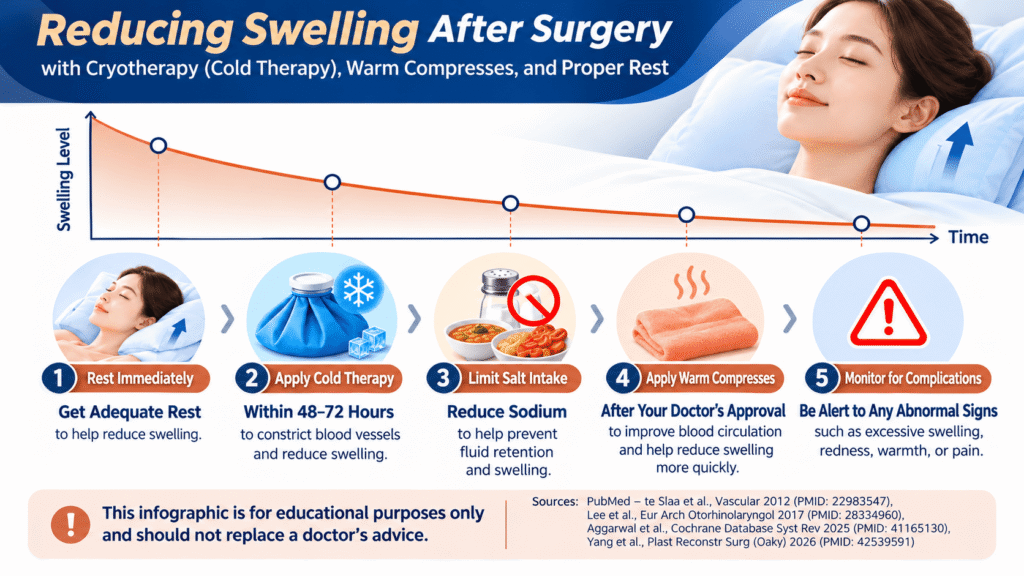
Cold Compresses in the Early Phase
A meta-analysis of post-rhinoplasty care found that the cold-compress group had significantly less swelling and periorbital bruising during the first 24 hours than the group that did not receive cold compresses. In other surgeries, such as knee replacement, a Cochrane academic article found that cryotherapy reduced swelling between postoperative days 2 and 6, but no long-term difference was found; some adverse effects were reported, such as discomfort, skin reactions, and cold-induced injury. A randomized study in eyelid surgery indicated that cold compresses provided short-term symptom relief.
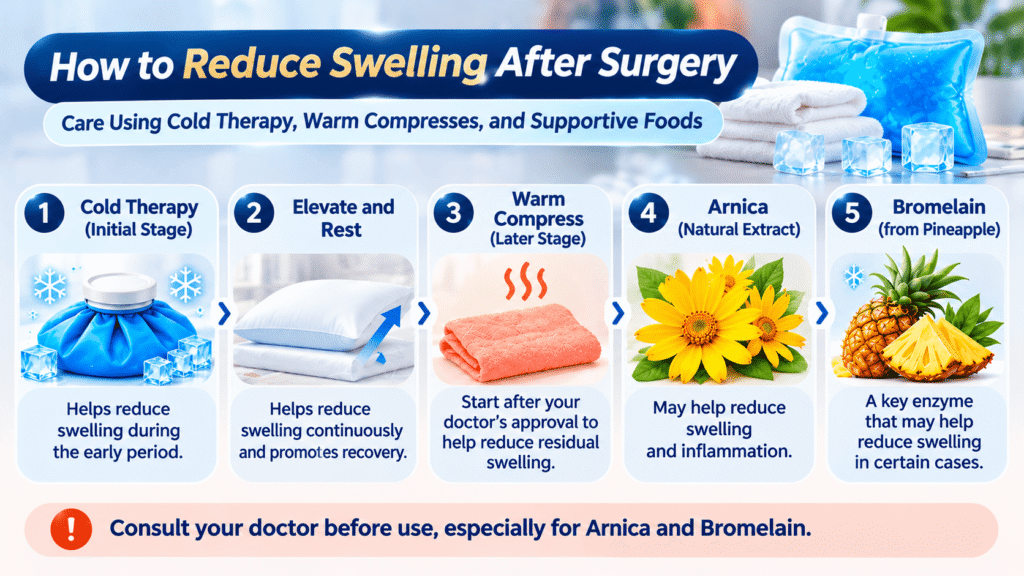
The general approach commonly recommended by surgeons is intermittent cold application during the first 48–72 hours, using a clean cloth wrapped around a cold gel pack or ice bag; ice should not be placed directly on the skin, and intervals of rest should be taken to prevent cold-induced skin injury. The appropriate duration and frequency should follow the attending physician’s instructions, particularly in areas where the skin is still numb from surgery, because cold may be perceived poorly.
Warm Compresses in the Subsequent Phase
After the acute inflammatory phase, some physicians may recommend warm compresses to promote comfort and circulation. However, evidence from research on warm compresses after surgery is much more limited than that for cold compresses; therefore, warm compresses should not be initiated without advice, and particular caution is required in areas where the skin is still numb because of the risk of burns.
Sleeping with the Head or Operated Part Elevated
Elevating the operated part above heart level (head elevation for facial procedures) allows gravity to assist fluid return and is one of the standard approaches used in postoperative swelling care. For facial procedures, patients are often advised to sleep with a high pillow or on an adjustable bed in the early phase and to avoid bending the head down for prolonged periods.
Compression Garments and Manual Lymphatic Drainage
For body procedures such as liposuction, wearing compression garments as advised helps reduce the space in which fluid can accumulate, and manual lymphatic drainage (MLD) by a trained practitioner is another approach used to reduce swelling. Both should be initiated only when permitted by the physician.
Nutrition: Sodium Reduction, Adequate Protein, and Evidence for Arnica/Bromelain
Foods That Support Recovery
Reduce sodium. Highly salty and processed foods cause the body to retain more water. Reducing salt intake during recovery is therefore a reasonable and low-risk approach.
Adequate protein. Protein is an essential material for tissue repair. An academic article on nutrition and wound healing states that the effectiveness of macronutrient supplementation has been well described, whereas evidence for vitamins and minerals remains less clear.
Drink sufficient water and avoid alcohol in the early postoperative period.
Arnica and Bromelain: What Is the Evidence ?
Arnica (extract of Arnica montana) and Bromelain (an enzyme from pineapple) are two frequently discussed names in swelling and bruising reduction, but research findings remain inconsistent.
A 2026 academic article compiling 10 studies (696 patients) in facial surgery found that most studies on Arnica showed bruising reduction at some time points, and two studies assessing swelling reported reductions; however, evidence for Bromelain remains limited, and differences in dosage make conclusions difficult.
A meta-analysis in rhinoplasty found that the Arnica group had reduced swelling and periorbital bruising in the first week.
Conversely, a randomized study in eyelid surgery found no significant benefit of either Arnica or Bromelain, and a dermatology article concluded that data are insufficient to support their postoperative use.
A caution is that herbal products and dietary supplements may interact with other medications or affect coagulation; therefore, patients should inform and consult their physician before use at all times, both before and after procedures.
Abnormal Swelling Signs Requiring Medical Attention and the PPSI Swelling-Reduction Program
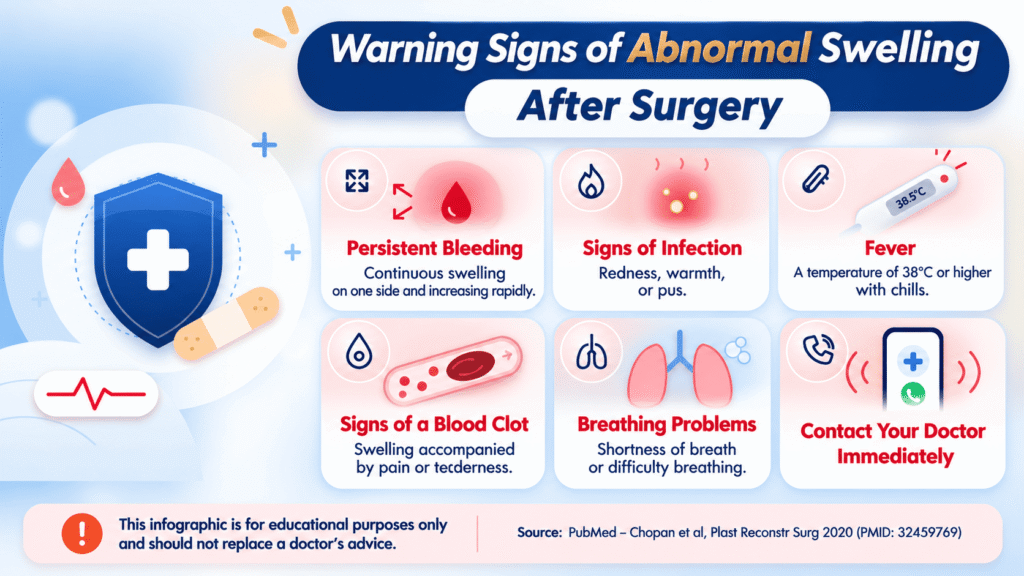
Normal swelling usually peaks during the first few days and then gradually decreases, and it is often similar on both sides. However, some complications require prompt care. From a database of more than 13,000 facelift patients, hematoma and infection are the most common surgical complications.
Signs That May Indicate Hematoma
Unilateral swelling that rapidly increases, or a feeling of marked tightness.
Increasing pain rather than gradual improvement.
Purplish bruising that rapidly expands.
For neck or facial procedures, if there is difficulty swallowing or breathing, the patient must go to the hospital immediately.
Signs That May Indicate Infection
Wound redness, heat, and increasing pain after an initial period of improvement.
Pus or malodorous fluid draining from the wound.
Fever or chills.
Other Symptoms for Which a Physician Should Be Contacted
Unilateral leg swelling, calf pain, or shortness of breath, which may be signs of a blood clot.
Skin around the wound becoming dark or abnormally cold.
If these symptoms occur, do not wait for spontaneous resolution; contact the surgical team immediately.
How PPSI Cares for You
At the Phuket Plastic Surgery Institute (PPSI), swelling care begins before the procedure through individualized assessment, review of current medications and supplements, and planning of recovery appropriate to each type of procedure. After the procedure, the medical and nursing team provides guidance on compresses, sleeping positioning, and the use of compression garments, along with follow-up appointments to assess swelling and wounds.
For appropriate patients, the swelling-reduction program may include manual lymphatic drainage (MLD) and use of compression garments according to the physician-prescribed schedule, with all steps under medical team supervision; clients can recover in Phuket’s relaxed atmosphere while receiving close follow-up.
Postoperative swelling is part of the natural healing process. Evidence-supported methods for reducing swelling include cold compresses in the early phase, elevation of the head or operated part, use of compression garments, and appropriate nutrition. Evidence for Arnica and Bromelain remains inconsistent, and physician consultation is required before use. Most importantly, patients should recognize abnormal signs and contact the medical team immediately when they occur. Consult a PPSI physician for individualized assessment and recovery planning suited to you.
Note: This article is intended for general educational purposes and cannot replace diagnosis or advice from a physician. Treatment and outcomes depend on individual assessment.
Frequently Asked Questions (FAQ)