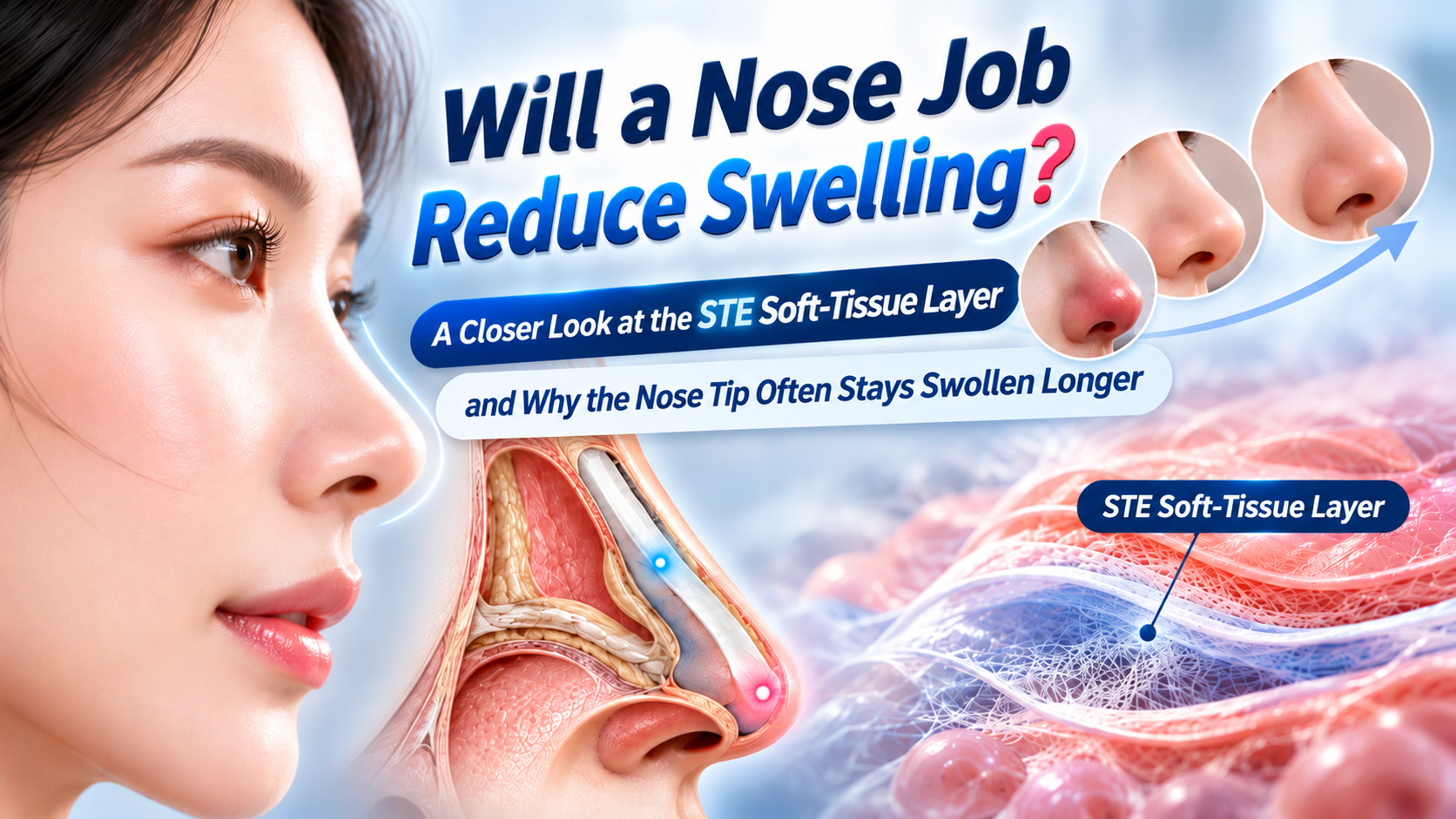
The final quarter of the year, especially October, is a key period or 'Golden Timeline' for those planning facial restructuring ahead of the year-end festive season. Rhinoplasty is one of the most popular procedures attracting significant interest. However, after the nasal splint is removed, many patients are often puzzled to find that 'the bridge is already taking shape beautifully, but why does the tip still look swollen, round, and unsettled?' The key questions that always follow are: 'How many days does swelling take to subside after rhinoplasty?' and 'Will I recover in time for nice photos during the New Year period?'
The answer to this phenomenon lies in the anatomy of the skin and soft tissue envelope covering the nose which varies in density and thickness along its length as well as the specific drainage pathways of the lymphatic system. This article compiles and synthesizes data from medical research in the PubMed database to explain why the nasal tip subsides more slowly than the bridge, supratip edema, a comparison between open and closed rhinoplasty techniques, and a detailed recovery timeline to help you plan your self-care effectively before the festive season.
Key Points About Recovery After Rhinoplasty:
- Uneven skin thickness: High-frequency ultrasound examination shows that the skin at the mid-bridge is the thinnest, while the skin at the nasal tip is noticeably thicker.
- Skin characteristics affect timing: Patients with thick skin tend to have swelling that persists longer, while those with thin skin may notice supratip fullness more clearly in the early period.
Surgical technique does not solely determine swelling: A meta-analysis confirms that open and closed rhinoplasty do not differ with statistical significance in terms of swelling resolution time, provided the surgeon maintains the correct dissection plane.
Swelling resolution is a continuous process: Swelling gradually decreases in a sequential manner throughout the 12-month period, with the nasal tip being the area that takes the longest to settle completely.
Anatomy of the Nasal Soft Tissue Envelope (STE)
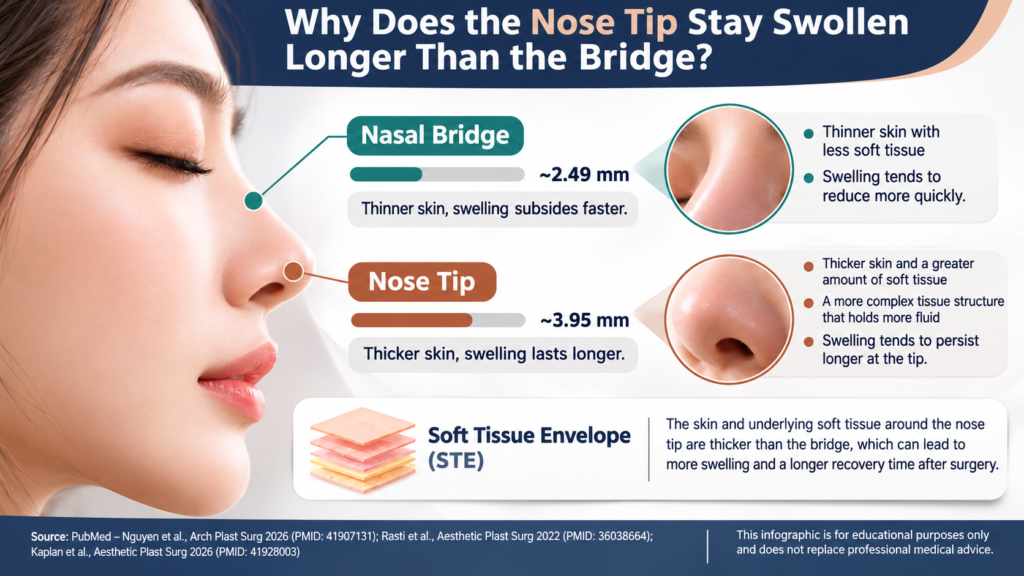
Plastic surgeons refer to all the skin and soft tissue covering the bony and cartilaginous framework of the nose as the Soft Tissue Envelope (STE). It consists of skin, subcutaneous fat, muscle layer, and the fascial layer (SMAS), which vary in thickness across different regions of the nose.
A prospective study of 35 patients using high-resolution ultrasound to measure STE thickness revealed the following interesting anatomical data:
- Radix to nasion region: thickest, averaging approximately 4.11 mm
- Nasal tip: second thickest, averaging approximately 3.95 mm
- Mid-dorsum (rhinion): thinnest, averaging only approximately 2.49 mm
- Sex differences: males have a significantly thicker STE than females
Why does the bridge settle and take shape faster than the tip? This thickness data helps clearly explain the phenomenon patients observe:
- Dorsum: has a thin skin layer closely adherent to the firm underlying bony framework. Once swelling begins to decrease even slightly, the sharp contour of the bridge becomes visible quickly.
- Tip and supratip: these areas have denser soft tissue. After surgery, this tissue layer requires time to "shrink-wrap" onto the newly refined cartilaginous framework, meaning the detail and definition of the tip visibly take longer to emerge.
Supratip Edema and Factors That Slow Its Resolution
What is supratip edema? Supratip edema is the accumulation of fluid and swelling in the tissue between the nasal bridge and the tip, causing the transition between the bridge and tip to appear blurred and lacking in definition; in some cases, it may make the tip look more prominent and bulky. If this condition is not managed appropriately, it can lead to fibrosis and permanent deformity known as supratip deformity.
Research on treating this condition has found that targeted injection of an appropriate dose of the corticosteroid triamcinolone acetonide is a safe and effective method for controlling and reducing supratip edema, helping lower the risk of fibrosis and reducing the need for future revision surgery.
Key Factors Contributing to Delayed Swelling Resolution
Skin thickness: A follow-up study measuring STE thickness by ultrasound at 3 and 10 months after surgery found that patients with thin skin develop noticeable swelling over the nasal bridge in the early period but it subsides quickly, whereas those with thick skin have swelling that persists longer. However, patients with thin skin may notice supratip fullness more clearly because there is no fat layer to camouflage it.
Revision rhinoplasty: A study comparing primary and revision surgery reported that after revision rhinoplasty, the STE is thicker than after primary surgery at every location and at every follow-up point (1, 3, 6, and 12 months), resulting in a slower rate of swelling resolution.
Dissection plane: A randomized comparative study found that dissection in the subperichondrial plane significantly reduces tip and supratip swelling in the first week compared with dissection in the sub-SMAS plane, but this difference disappears by 1 month after surgery.
Clinical Management Guidelines by the Surgeon
Plastic surgeons apply several techniques in combination to manage swelling, including nasal taping to reduce dead space beneath the skin and tighten the tissue, targeted local steroid injections at sites prone to fibrosis, and consideration of oral steroids in certain patients. All of these steps must be carried out under the supervision and clinical judgment of a specialist physician only.
Open Rhinoplasty and Its Effect on the Lymphatic Circulation
Open rhinoplasty involves a columellar incision at the base of the nose connected to incisions inside the nostrils, opening the skin layer so the surgeon can clearly see the internal structures. Closed rhinoplasty, by contrast, is performed only through incisions inside the nostrils. A common question that arises is: 'Does the columellar incision cut lymphatic pathways and cause the nasal tip to stay swollen longer?'
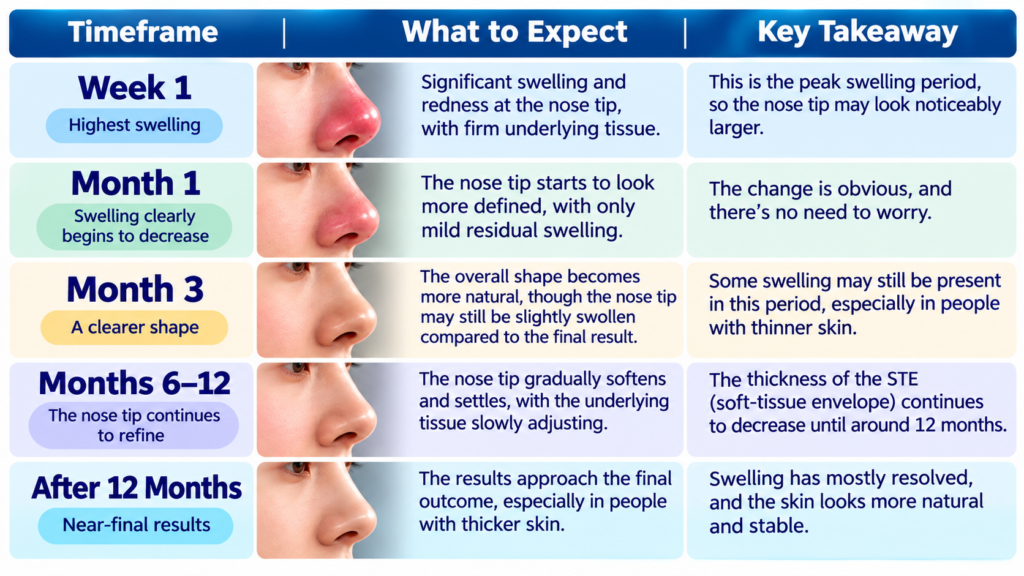
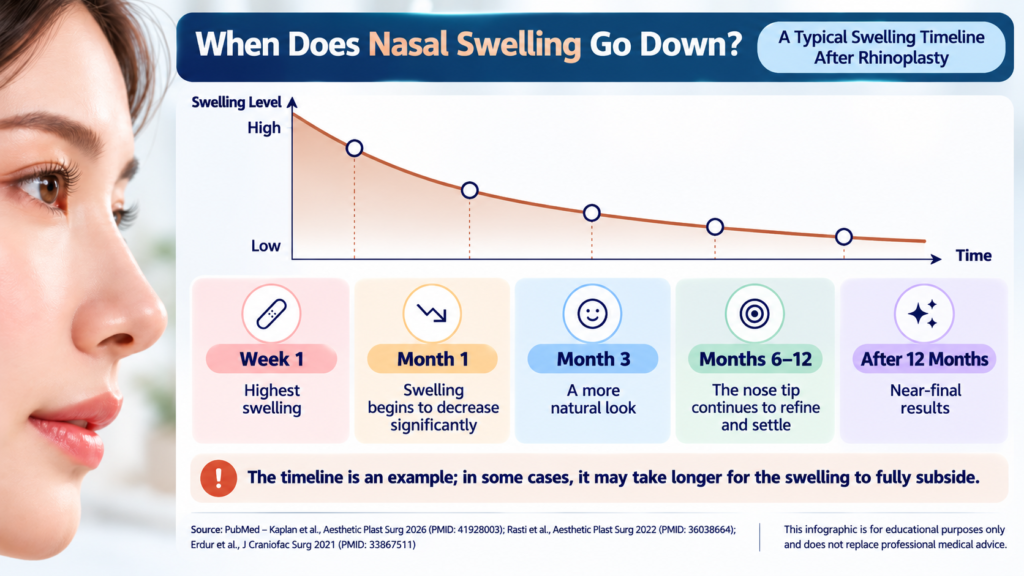
Recovery & Swelling Timeline
The tissue recovery process after rhinoplasty is a continuous process, with an approximate timeline based on high-frequency ultrasound measurements of STE thickness, as follows:
Pre-Festive Season Planning and Preparation Guidelines: How to Plan Surgery in Time for New Year Photos?
- Optimal timing: Undergoing surgery in mid-to-late October allows approximately two months or more of recovery before the New Year festive season—enough time for severe swelling and bruising to fade and for the nasal bridge to take clear shape, even though the tip will continue to change.
- Patients with thick skin or undergoing revision surgery: Allow more recovery time than usual, since the tissue takes longer to contract than after primary surgery.
- Tracking recovery: Taking photos of the nose from the same angle and lighting every month is recommended to objectively track progress, since gradual changes are often hard to notice when looking in the mirror every day.
- Important precautions: Avoid squeezing, massaging, or pressing on the nose yourself, and refrain from wearing glasses that press on the nasal bridge until approved by the treating surgeon.
- Recovering in a tourist destination: For those traveling to recover at a medical center in Phuket during the late-year period—a comfortable tourist season—you can relax while receiving follow-up care, splint removal, and close monitoring of swelling by the medical team.
The main reason the nasal tip subsides and settles more slowly than the bridge lies in the anatomy: the soft tissue and skin layers there are thicker, so it takes time for them to shrink and conform to the new cartilaginous framework. Thick skin and revision surgery contribute to longer swelling duration, while the open technique does not cause longer swelling than the closed technique, provided surgery is performed in the correct tissue plane to preserve the lymphatic system.
The swelling resolution process continues throughout the 12-month period. Starting to plan and undergo surgery from October onward is therefore highly suitable for preparing facial structure to look good before the year-end festive season. For those who want precise assessment of nasal structure and skin thickness, a direct consultation and evaluation by specialist plastic surgeons at PPSI is recommended to plan the most individually appropriate surgery.
FAQ
Q1: How many months does the nasal tip take to settle and achieve its final shape?
Answer: The nasal tip is the area that takes the longest to settle. Although most swelling decreases noticeably in the first month, the thickness of the soft tissue envelope continues to decrease and contract progressively until around 12 months after surgery. In patients with thick skin, this process may take longer. The best way to track results is to take photos from the same angle every month and attend regular follow-up appointments with the surgeon. If the tip appears unusually bulky or firm, the doctor may consider additional management, such as targeted steroid injections.
Q2: Does thick nasal skin really slow down swelling resolution?
Answer: Yes. Clinical research confirms that patients with a thick soft tissue envelope (STE) have swelling over the bridge and tip that persists longer, because the greater amount of soft tissue requires time to adjust and contract onto the new cartilaginous framework. Conversely, patients with thin skin resolve swelling faster but may notice supratip fullness more clearly in the early period because there is no fat layer to conceal it. Skin thickness is therefore an important factor that surgeons must always assess before surgery.
Q3: Does open rhinoplasty cause longer swelling than closed rhinoplasty?
Answer: Not necessarily. Current medical meta-analyses find no significant difference in swelling resolution time between open and closed rhinoplasty. What influences swelling more is the dissection plane. If the surgeon performs meticulous dissection in the subperichondrial plane, it helps preserve the main lymphatic vessels, allowing normal fluid drainage and effectively reducing tip swelling.
Q4: Why do men often have longer swelling after rhinoplasty than women?
Answer: High-frequency ultrasound measurements show that men have a significantly thicker and denser soft tissue envelope (STE) than women. When the tissue layer is thicker, the body requires a longer period to reduce swelling and contract the tissue. However, skin thickness is an individual characteristic, so a direct evaluation by a physician is always recommended.
References (PubMed)
Nguyen CD, Nguyen NB, Ho HM, et al. Ultrasonographic Evaluation of Nasal Tip Anatomy for Rhinoplasty Planning. Arch Plast Surg. 2026;53(2):142-150. doi:10.1055/a-2802-5847. PMID: 41907131. https://pubmed.ncbi.nlm.nih.gov/41907131/
Toriumi DM, Mueller RA, Grosch T, et al. Vascular anatomy of the nose and the external rhinoplasty approach. Arch Otolaryngol Head Neck Surg. 1996;122(1):24-34. doi:10.1001/archotol.1996.01890130020003. PMID: 8554743. https://pubmed.ncbi.nlm.nih.gov/8554743/
Erdur ZB, Öktem F, Inci E, et al. Effect of Nasal Soft-Tissue Envelope Thickness on Postoperative Healing Process Following Rhinoplasty. J Craniofac Surg. 2021;32(6):2193-2197. doi:10.1097/SCS.0000000000007697. PMID: 33867511. https://pubmed.ncbi.nlm.nih.gov/33867511/
Kaplan GO, Tan AA, Yıldızdal S. Comparison of Postoperative Edema Between Sub-SMAS and Subperichondrial Dissection Planes in Rhinoplasty Using Ultrasonographic Skin Thickness Measurements. Aesthetic Plast Surg. 2026;50(13):4893-4899. doi:10.1007/s00266-026-05810-6. PMID: 41928003. https://pubmed.ncbi.nlm.nih.gov/41928003/
Abi Zeid Daou C, Jalkh RM, Semaan ZM, et al. Outcomes of Open Versus Closed Rhinoplasty, a Systematic Review and Meta-analysis. Plast Reconstr Surg Glob Open. 2025;13(8):e7047. doi:10.1097/GOX.0000000000007047. PMID: 40771258. https://pubmed.ncbi.nlm.nih.gov/40771258/
Rasti M, Rasti S, Behshadnia F. Evaluation of Skin-Soft Tissue Envelope Thickness by Ultrasonography after Primary and Revision Rhinoplasty. Aesthetic Plast Surg. 2022;47(2):738-745. doi:10.1007/s00266-022-03053-9. PMID: 36038664. https://pubmed.ncbi.nlm.nih.gov/36038664/
Khan M, AlRajhi B, Turkistani L, et al. Efficacy and Safety of Triamcinolone Acetonide Injections Following Rhinoplasty: A Systematic Review of Recommended Doses, Complications, and Outcomes. Aesthetic Plast Surg. 2024;48(15):2818-2828. doi:10.1007/s00266-024-03967-6. PMID: 38519572. https://pubmed.ncbi.nlm.nih.gov/38519572/
Ganesh Kumar N, Sherif R, Rohrich RJ. Postoperative care in primary and revision rhinoplasty-A survey-based study. J Plast Reconstr Aesthet Surg. 2025;111:35-42. doi:10.1016/j.bjps.2025.09.016. PMID: 41151316. https://pubmed.ncbi.nlm.nih.gov/41151316/