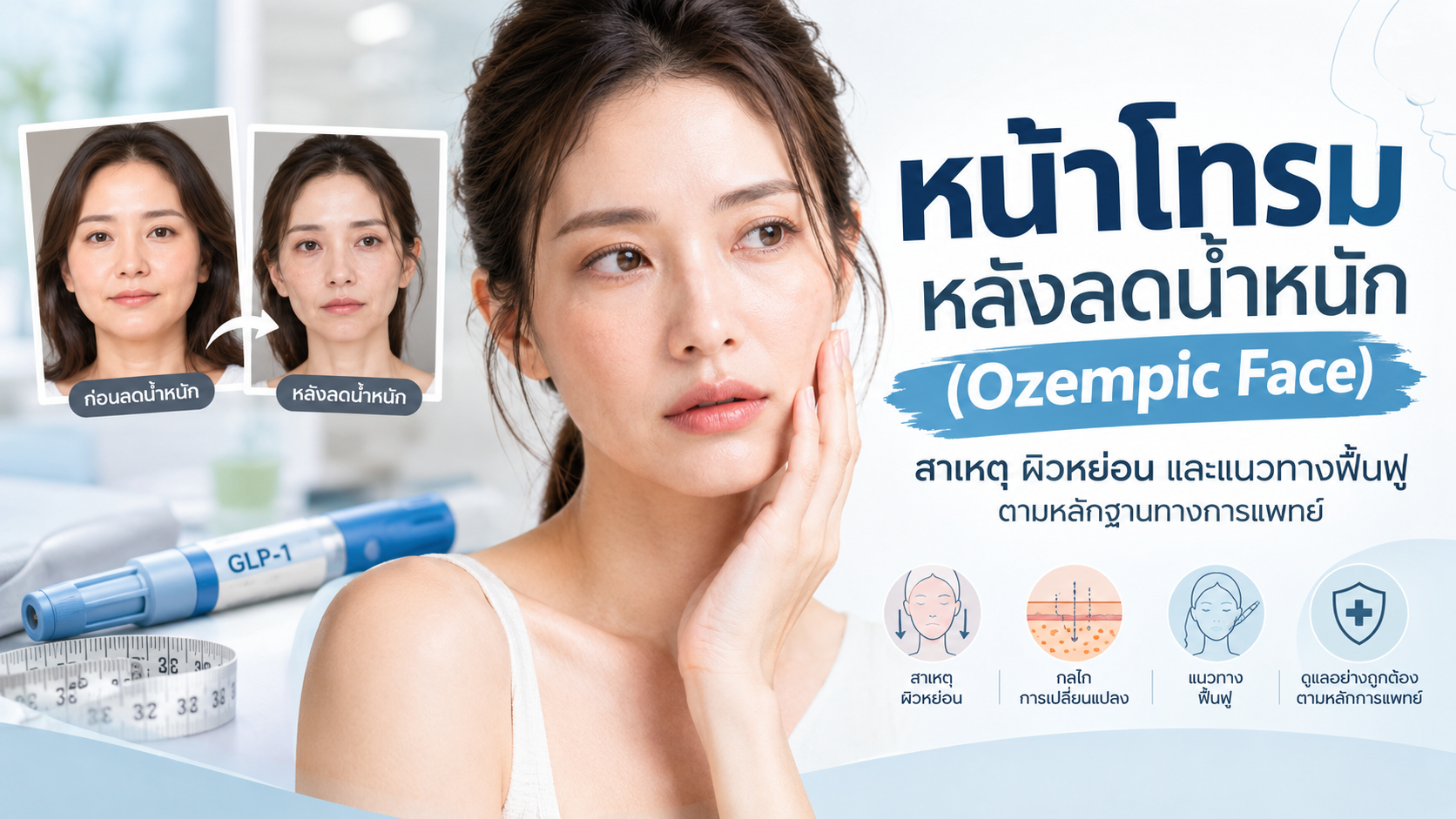
During the year-end festive season and year-end campaigns, it is the time when many people want to look their best for parties and family gatherings. Nowadays, many people can successfully lose weight with GLP-1 Receptor Agonist drugs such as Semaglutide in the form of "weight-loss pens."
However, many people face problems with gaunt faces, sunken cheeks, deeper folds, dull skin, and sagging that makes them look older than before. This phenomenon is known in the media as "Ozempic Face." This article will help everyone understand the causes, anatomical mechanisms, and medically sound restoration approaches.
Key highlights
Not a result of the drug alone: "Ozempic Face" is caused by facial volume loss from significant weight loss, which can also be seen with other weight-loss methods.
Facial fat loss is uneven: The subcutaneous fat structure is divided into compartments, with superficial fat decreasing more than deep fat, resulting in a noticeably gaunt appearance.
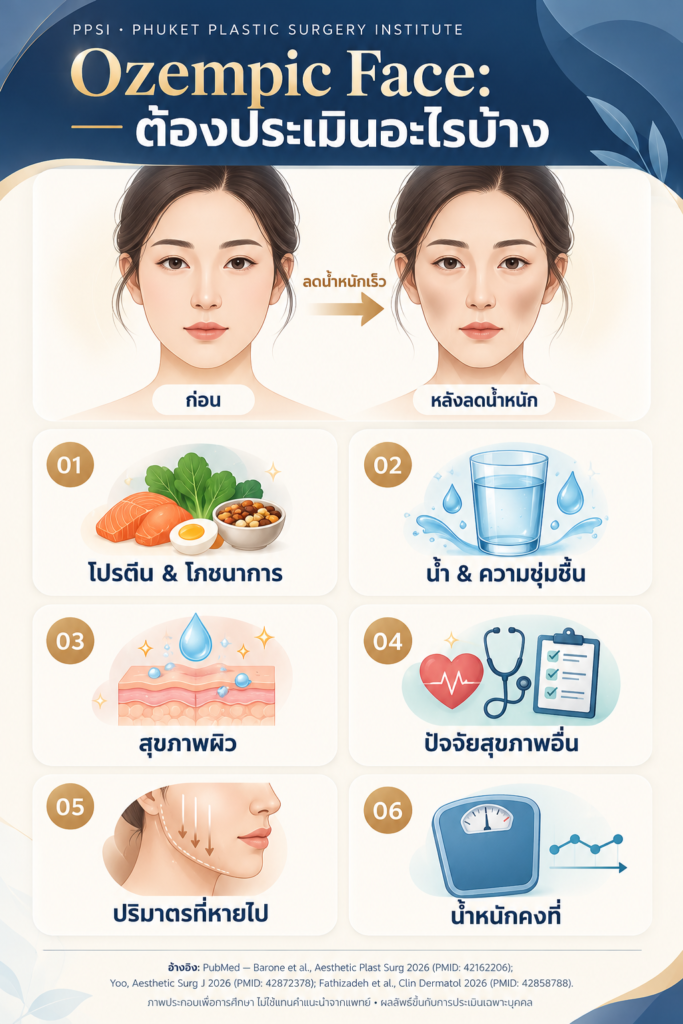
Comprehensive assessment is needed: Caring for dull skin after weight loss requires evaluating nutrition (especially protein), hydration, skin health, and lost volume.
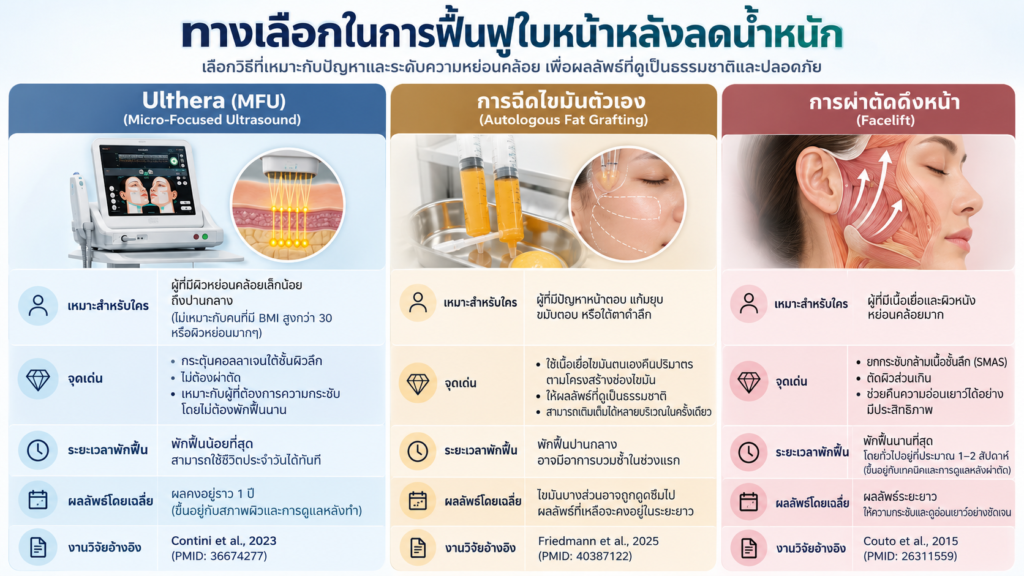
Various restoration options: These range from Ulthera lifting for mild to moderate skin laxity, autologous fat grafting to restore volume, to facelift surgery for those with significant sagging.
Weight should be stable first: Major procedures or surgery should be planned only when weight has reached the target and stabilized.
.
1. Why does facial fat deflate unevenly? (Facial Fat Compartments)
In the past, it was believed that the subcutaneous fat of the face was a single continuous sheet. However, anatomical studies by Rohrich and Pessa found that subcutaneous fat is divided into well-defined "compartments" that change unevenly. For example:
Nasolabial fat and malar fat: subdivided into medial, middle, and lateral temporo-zygomatic compartments.
Forehead and periorbital fat: divided into multiple compartments along septal boundaries.
Jowl fat: the lowest compartment.
This concept clearly explains why weight loss causes certain areas—such as the temples, under the eyes, and mid-cheeks—to appear more hollow than others.
Techniques to help you follow the plan more easily
- Ask for written instructions and ask clearly until you understand "what to do, when, and for how long."
- Set reminders on your phone for medication times, changing silicone sheets, or appointment dates.
- Take photos of the wound and keep them, taking them consistently from the same angle and lighting so the doctor can compare progress.
- Contact the medical team immediately if you notice abnormal symptoms; do not wait until the appointment date.
2. Why do GLP-1 users develop gaunt faces and sagging skin?
A recent literature review in the Aesthetic Surgery Journal indicates that midface volume decreases by approximately 7% for every 10 kilograms of weight lost, with superficial fat decreasing by as much as 11% compared to a 7% decrease in deep fat. The mechanisms behind these facial changes include:
Loss of subcutaneous fat and dermal fat: causing the face to lose the volume that once supported the skin.
Decreased muscle mass (sarcopenia) and skeletal changes: reducing the facial support structure.
Changes in skin quality: skin becomes thinner, losing collagen fibers, elastin, and elasticity, resulting in wrinkles and premature aging.
Tissue sagging: when subcutaneous volume decreases but the skin cannot contract quickly enough, sagging and deep folds occur.
📌 Factors that worsen skin changes: increasing age, a history of long-term obesity, rapid weight loss, inadequate water intake, and insufficient protein intake.
3. What must be assessed before restoring skin after weight loss
If you feel that your skin looks dull, lackluster, and wrinkled after weight loss, medical professionals will use a comprehensive health assessment approach based on the "Health-First Approach" as follows:
Nutrition and protein: Check adequate protein and nutrient intake to help maintain muscle mass and tissue.
Water and hydration: Drinking too little water is directly linked to worsening skin changes.
Skin health: Assess thickness, elasticity, wrinkles, and sun damage to the skin.
Other health factors: Such as underlying diseases, medication use, smoking, or menopause.
Volume loss and laxity: Analyze whether the main problem is "volume loss," "skin laxity," or "both" in order to choose the right treatment.
Weight stability: Assess whether weight has stabilized to prevent results from changing if weight continues to decrease.
4. Facial restoration options after weight loss
5. The appropriate timing for treatment (When to Treat?)
While actively losing weight: Focus primarily on taking care of your overall health and skin, including eating sufficient food and protein, drinking plenty of water, nourishing the skin, and protecting it from sunlight.
Before major procedures (such as a facelift or fat grafting): You should wait until your weight has reached the target and remained stable for several months so that facial structure and treatment results do not change with further weight loss.
Precautions regarding medication use: You must always inform the surgeon and anesthesiologist about the use of [the GLP-1] drug group. *(Note: The Thai source text appears to be cut off at the end after "ยากลุ่ม" / "drug group".)GLP-1, and you must absolutely not stop or adjust the medication on your own. You should also consult with the doctor overseeing your weight loss.
References.
Rohrich RJ, Pessa JE. The fat compartments of the face: anatomy and clinical implications for cosmetic surgery. Plast Reconstr Surg. 2007;119(7):2219-2227. PMID: 17519724
/
Yoo KH. Glucagon-Like Peptide-1 Receptor Agonist-Associated Facial Changes: A Comprehensive Review... Aesthet Surg J. 2026. PMID: 42872378
Fathizadeh S, Hwang AS, Hoss E. "Ozempic Face" and Facial Aging. Clin Dermatol. 2026. PMID: 42858788
/
Barone M, Brunetti B, D'Emilio R, et al. Effects of GLP-1 Receptor Agonists on Skin Quality: A Comprehensive Literature Review. Aesthetic Plast Surg. 2026;50(13):5403-5407. PMID: 42162206
/
Daneshgaran G, Shauly O, Gould DJ. "Ozempic Face" in Plastic Surgery: A Systematic Review... Aesthet Surg J Open Forum. 2025;7:ojaf056. PMID: 40626110
/
Contini M, Hollander MHJ, Vissink A, et al. A Systematic Review of the Efficacy of Microfocused Ultrasound for Facial Skin Tightening. Int J Environ Res Public Health. 2023;20(2). PMID: 36674277
/
Friedmann DP, Hinchee-Rodriguez K, Verma KK. Temple Volumization With Autologous Fat: A Systematic Review of the Literature. Dermatol Surg. 2025;51(10):959-966. PMID: 40387122
/
Couto RA, Waltzman JT, Tadisina KK, et al. Objective Assessment of Facial Rejuvenation After Massive Weight Loss. Aesthetic Plast Surg. 2015;39(6):847-55. PMID: 26311559