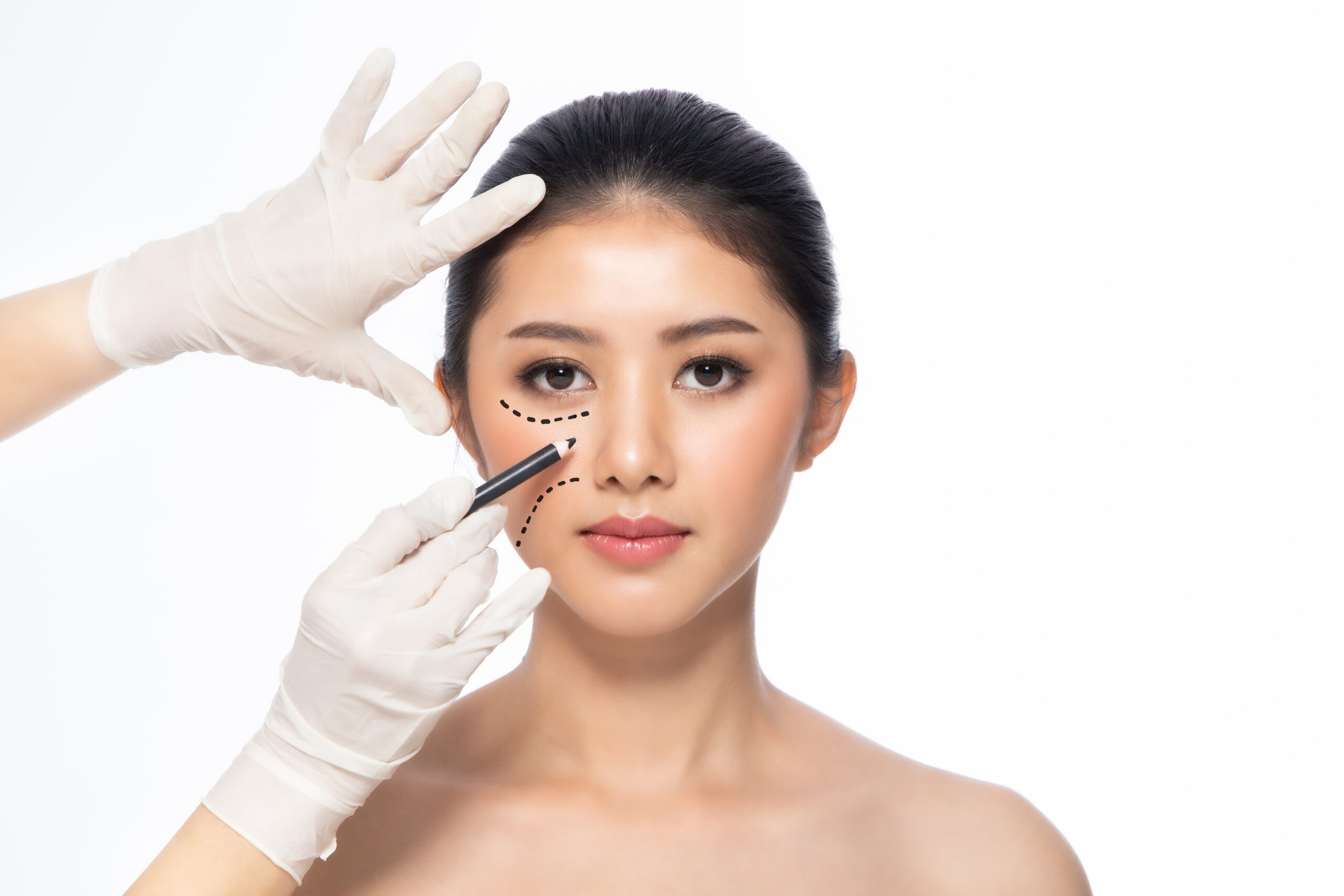
Have you ever felt that your face always looks tired, even after getting enough rest? The cause may not be just under-eye bags alone, but may involve deepening tear troughs, cheeks that have lost volume, or sagging midface tissue with age.
In our October Double Transformation campaign, we'll explore why overall facial assessment is important—especially for those considering a facelift combined with eye surgery (Facelift + Blepharoplasty) rather than correcting only under-eye bags.
This article explains the concept of the Periorbital–Midface Continuum—the continuity between the area around the eyes and the midface—from the anatomy of the lid-cheek junction, the tear trough, and the malar fat pad, to age-related changes, the limitations of eye surgery alone, combined surgical planning, and considerations during recovery. It is compiled from research referenced in the PubMed database.
Understanding the Anatomy of the Tear Trough and Midface
Tear Trough and Lid-Cheek Junction
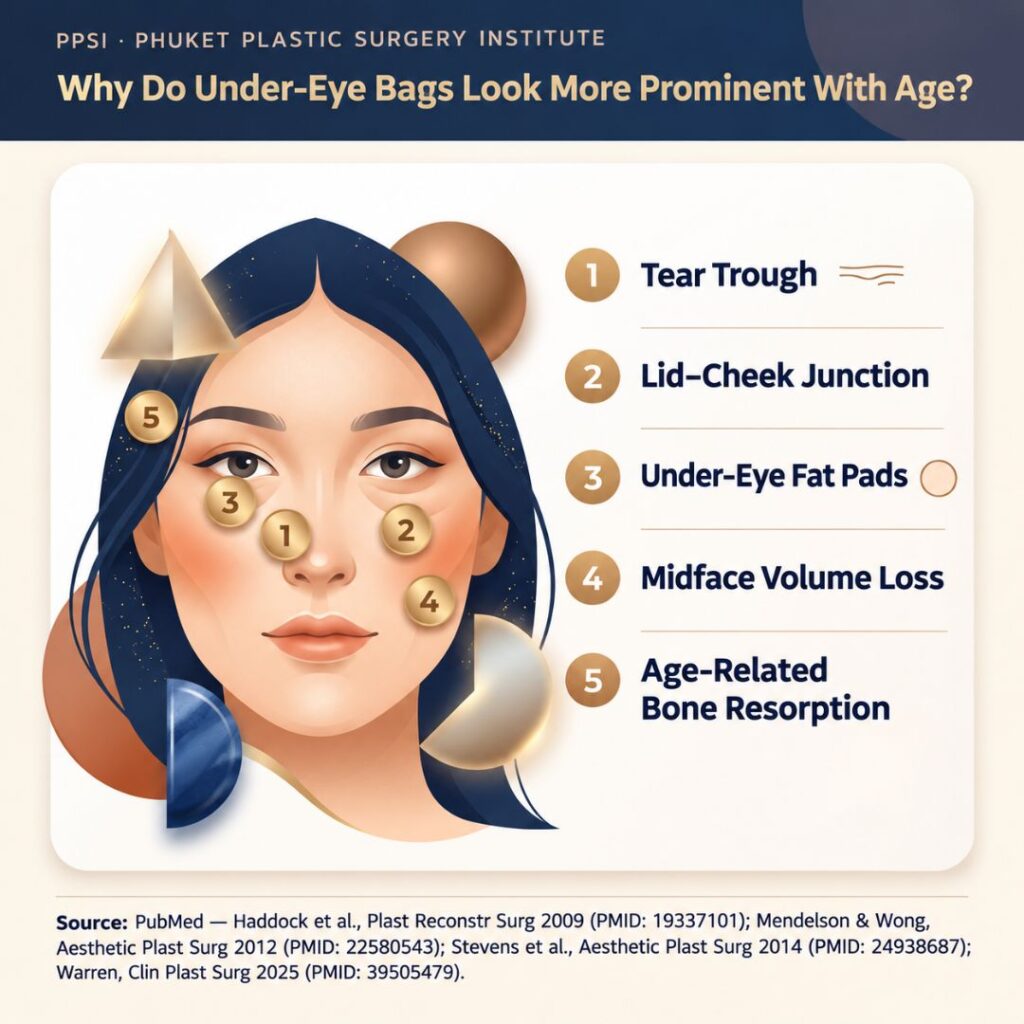
The tear trough is a groove that begins at the inner corner of the eye and extends down toward the inner cheek. The lid-cheek junction is the boundary between the lower eyelid and the cheek that continues laterally. With age, both areas may become prominent enough to be visible as a long line beneath the orbital rim.
Cadaveric dissection studies have found that in the subcutaneous layer, these grooves are associated with the junction of the orbicularis oculi muscle between the palpebral and orbital portions, as well as the upper border of the malar fat pad.
In deeper layers, the tear trough area has muscle attached directly to bone, while the lid-cheek junction area contains a retaining structure called the orbicularis retaining ligament.
Study results suggest that the increasing prominence of tear troughs with age can be explained by atrophy of the skin and subcutaneous fat. At the same time, orbital fat that bulges forward to create under-eye bags further accentuates the groove. Correction may therefore need to address tissue beneath the orbital rim, not just be limited to the eyelid.
Malar Fat Pad and Its Role in Supporting the Lower Eyelid
Beneath the lid-cheek junction lie the malar fat pad and midface tissue, which sit above the zygomatic bone and maxilla. These tissues help support the lower eyelid area and create continuity between the eyes and cheeks.
When tissue volume decreases or tissue descends with age, support in this area may change, causing the lower eyelid to appear longer and the tear trough to become more pronounced.
For this reason, assessment of periorbital problems should consider the relationship between the lower eyelid and the cheek, rather than always viewing under-eye bags as an isolated problem.
Why Do Under-Eyes Look More Tired with Age?
Age-related facial changes occur at multiple levels, from bone to skin and soft tissue, and each component is interrelated.
Bone-Layer Changes
Research on facial skeleton and aging indicates that certain bone areas tend to resorb with age in a predictable pattern, particularly the midface, the maxilla beside the nose, certain areas of the orbital rim, and the anterior mandible.
When the bony foundation changes, overlying soft tissue may lose support, affecting facial contour. Research on the lid-cheek junction also indicates that changes in the lower orbital rim and maxilla, together with reduction of cheek tissue, contribute to the prominence of the tear trough.
Soft-Tissue Changes
In addition to bone, fat and skin may thin, while ligaments and muscles change with age.
A report from surgeons who performed midface lifting combined with lower blepharoplasty in more than 500 patients described that descent of the orbicularis oculi muscle and midface tissue may be associated with malar mounds, loss of volume above the tear trough, a longer-appearing lower eyelid, and a more defined orbit-cheek junction.
However, in academic discussion, there is still debate regarding the roles of tissue atrophy versus tissue descent—which mechanism is more important. Anatomical studies indicate that some structures in the tear trough area are attached to bone, so not all changes can be explained by descent alone. Meanwhile, lower cheek tissue has been reported to show both volume loss and descent.
Therefore, treatment planning should consider the mechanisms involved in each individual's face, rather than applying a single explanation to all patients.
Considerations for Asian Faces
A study of facelifts in 1,026 Chinese patients found that anatomical differences affect surgical planning, with emphasis on correcting sagging tissue such as brow tail descent and descended malar fat, while tailoring techniques to each individual.
This data reflects the importance of assessing facial structure before selecting surgical techniques, especially in Asian patients who may have different anatomical characteristics.
Why Might Eye Surgery Alone Be Insufficient?
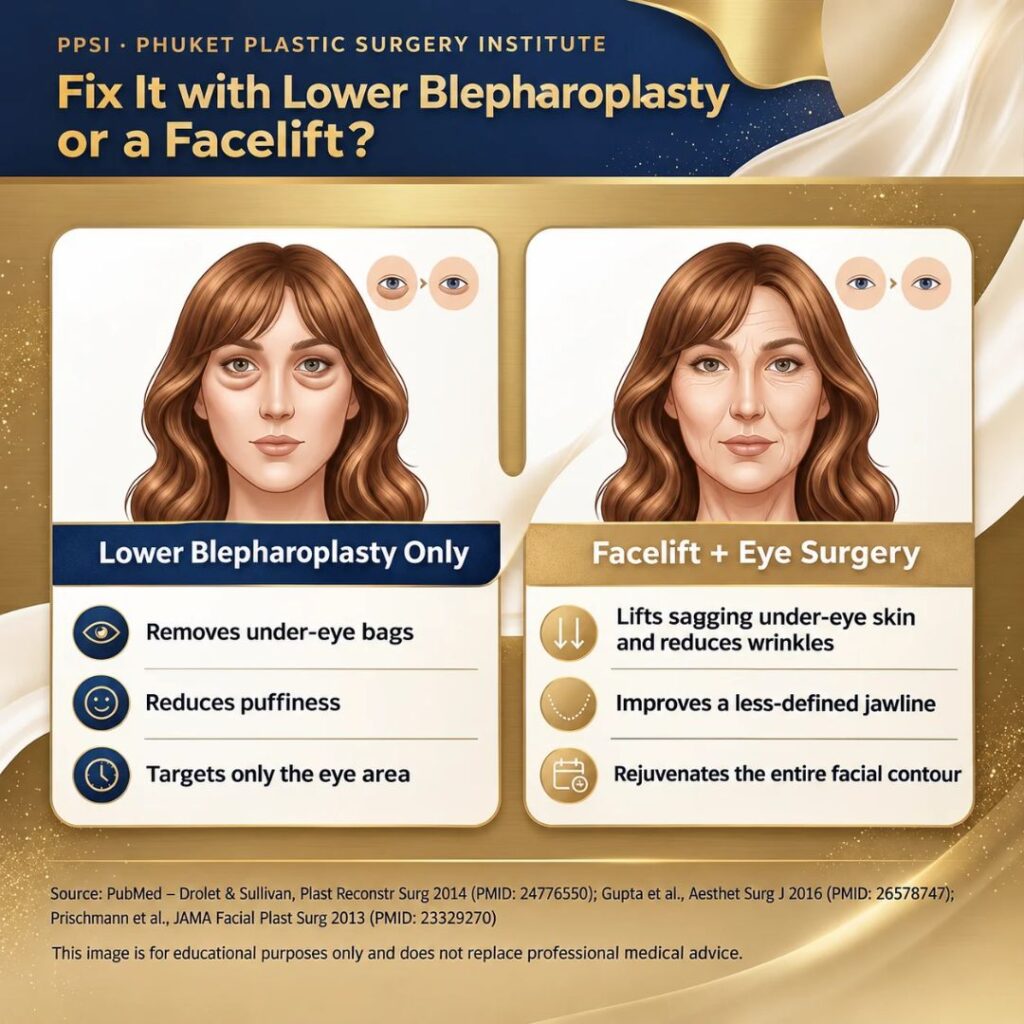
Lower blepharoplasty can help correct bulging orbital fat and adjust the lid-cheek junction or tear trough.
Current approaches to lower eyelid surgery emphasize appropriate fat management, which may include partial fat excision and fat repositioning to fill the tear trough area, rather than removing all fat alone.
However, if the main cause of a tired-looking face comes from cheeks that have lost volume or sagged, as well as sagging skin in the lower face, correcting only the eyelid may not restore continuity across all facial areas.
It can be compared to the lower eyelid being part of a structure connected to the cheek. If the cheek loses volume or support, adjusting only the eyelid may not be enough to achieve overall balance.
Research on the lid-cheek junction indicates that treatment addressing both the lower eyelid and cheek may yield better results in patients with problems in both areas, while the concept of evaluating the lower eyelid as part of the midface is gaining more attention.
Example Problems and Possible Approaches
Case 1: Bulging under-eye bags but cheeks still full
This may involve bulging orbital fat. Lower blepharoplasty with fat repositioning may be a consideration.
Case 2: Deep tear troughs and flat cheeks
There may be volume loss in both the lower eyelid area and midface. Lower eyelid surgery combined with volume restoration or midface lifting may be considered.
Case 3: Under-eye bags, sagging cheeks, and poorly defined jawline
When multiple areas are affected, the appropriateness of facelift combined with eyelid surgery may need to be assessed.
Case 4: Minor wrinkles around the eyes but no under-eye bags
If the main issue is skin quality, skin care or non-surgical procedures may be considered as appropriate.
These examples are only guidelines for understanding, not automatic treatment indications. Treatment selection requires examination and assessment by a plastic surgeon.
Planning a Facelift Combined with Eye Surgery
Facelift combined with eye surgery should be planned so that correction of each area supports the other—for example, lifting midface tissue may help improve support of the lower eyelid area, while fat repositioning beneath the eyes helps restore continuity of the tear trough.
Some techniques for midface lifting combined with lower eyelid surgery can address orbital fat, sub-orbicularis fat, and the skin-muscle layer separately.
The goal of assessment is therefore not merely choosing how many areas to operate on, but identifying which structures are the primary source of the problem and how each surgical component will help correct those problems.
Recovery When Facelift Is Combined with Eye Surgery
One advantage of combined surgery is that recovery can be consolidated into a single period, rather than having separate recoveries from each procedure.
However, operating on multiple areas at once may cause more extensive swelling and bruising initially. These symptoms gradually subside through the healing process, with duration varying according to the technique chosen and each individual's physical condition.
Postoperative follow-up is important, especially assessment of wounds and eye-related symptoms such as dry eye, so the surgeon can adjust care appropriately.
Postoperative care guidelines that may be recommended include:
- Sleeping with the head elevated as advised by the surgeon
- Applying cold compresses according to the method and duration specified by the surgeon
- Avoiding bending the head down or lifting heavy objects during recovery as advised
- Using artificial tears or eye drops as prescribed
- Monitoring and controlling blood pressure as advised to reduce the risk of hematoma
Patients should follow individualized instructions and attend follow-up appointments regularly.
How Does PPSI Plan Care?
At PPSI, preoperative assessment focuses on the whole face—from the eyelids, tear troughs, cheeks, and jawline to skin quality—to understand which factors contribute to facial fatigue.
After assessment, the surgeon will explain potentially suitable options, whether eye surgery alone, facelift, or combined surgery, while considering dry eye conditions and related health factors before decision-making.
For those traveling to Phuket for recovery, planning the follow-up appointment schedule is an important part of care, so the surgeon can examine wounds and assess symptoms before the patient returns home as appropriate.
Frequently Asked Questions (FAQ)
Is eye surgery alone sufficient, or is a facelift also necessary?
It depends on the main cause of the problem. If there are bulging under-eye fat bags but the cheeks still have appropriate volume, lower eyelid surgery with fat repositioning may be sufficient in some cases.
But if there are deep tear troughs combined with flat or sagging cheeks and a poorly defined jawline, correcting only the eyelid may not address all problems, because the lower eyelid and midface are anatomically continuous. Combined treatment may therefore be more appropriate in some patients.
The final decision requires examination and assessment by a plastic surgeon.
What is the tear trough?
The tear trough is a groove under the eye that begins at the inner corner and extends down toward the inner cheek. In this area, the orbicularis oculi muscle is attached directly to bone. When skin and fat in this area atrophy with age, together with bulging orbital fat, the groove may appear deeper and make the face look tired.
Treatment approaches may include lower eyelid fat repositioning or other methods depending on the cause and each individual's assessment.
Can upper eyelid, lower eyelid, and facelift surgery be performed together?
This can be considered in appropriate patients, but performing upper and lower eyelid surgery together is associated with an increased chance of dry eye and conjunctival swelling. At the same time, adding procedures to a facelift may increase the risk of certain complications.
The surgeon must therefore assess eye health, tissue condition, and overall risk before planning surgery.
How long do facelift and eye surgery results last?
Surgery helps adjust the position and volume of tissue in the treated areas, but age-related changes in bone and soft tissue continue.
Skin care, sun protection, and maintaining stable weight are self-care approaches that may help support appearance in the long term. However, results and longevity vary among individuals.
Assess the Whole Face Before Choosing Surgery
The lower eyelid and midface are interrelated both anatomically and in age-related changes. Deep tear troughs, under-eye bags, and sagging cheeks may therefore have more than one contributing factor.
For those whose main problem is under-eye bags, lower eyelid surgery with fat repositioning may be a suitable option. But if there is also volume loss or sagging of the cheeks, facelift combined with eye surgery may help provide more comprehensive correction in appropriate patients.
The key is not choosing surgery in as many areas as possible, but understanding the cause of the problem, evaluating benefits and risks, and planning treatment suited to each individual's facial structure.
If you are considering Double Transformation to refresh your facial appearance at the end of the year, consult a surgeon for individualized assessment before making a decision.